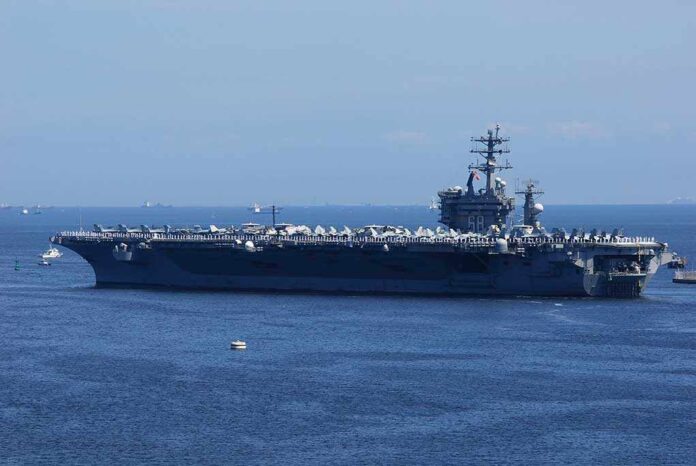
The rapid deployment of three U.S. Navy supercarriers signals a strategic shift aimed at countering threats from Iran while ensuring global maritime dominance.
Story Highlights
- The U.S. Navy redeployed three supercarriers amid Iran’s escalating unrest.
- The deployments include the USS Abraham Lincoln, Theodore Roosevelt, and George H.W. Bush.
- This strategic move aligns with Trump’s deterrence policies.
- The new U.S.-led air defense initiative in Qatar strengthens regional security.
Strategic Redeployment of U.S. Supercarriers
The U.S. Navy has initiated a significant redeployment of three supercarriers to bolster its force posture in response to increasing unrest in Iran. The USS Abraham Lincoln, previously stationed in the Indo-Pacific, has been redirected to the Middle East, while the USS Theodore Roosevelt and USS George H.W. Bush have departed from Norfolk. This coordinated strategy aims to strengthen deterrence amidst turmoil in Iran, where widespread protests threaten regional stability.
The U.S. Navy Just Deployed 3 Supercarriers in ‘Coordinated Strategy’https://t.co/5WZ9C6o7Qp
— 19FortyFive (@19_forty_five) January 17, 2026
These movements are part of a broader “layered maritime posture” aimed at reinforcing U.S. military warnings to Iran. Amidst Trump’s second term, the administration’s focus on maintaining a robust military presence is clear, as these deployments reflect a departure from routine procedures by foregoing full training cycles to expedite readiness.
Implications of the New Air Defense Cell in Qatar
Parallel to the carrier redeployments, the U.S. has established a new air defense cell in Qatar. This initiative is intended to enhance defensive capabilities against potential Iranian aggression. With the Al Udeid base hosting around 10,000 U.S. personnel, this development underscores the strategic importance of Qatar in the region. The air defense cell aims to integrate missile defense systems, ensuring rapid response capabilities in the face of increased threats from Tehran.
While these actions reinforce the U.S. commitment to its Middle Eastern allies, they also highlight the ongoing geopolitical tensions and the necessity for strategic military readiness. The deployment of advanced naval assets, such as the F-35C fighters aboard the USS Abraham Lincoln, enhances the U.S.’s ability to project power and maintain security in critical areas.
Economic and Political Impact
The economic implications of maintaining such a force posture are substantial, as the operation costs for carrier strike groups are significant. Politically, these moves bolster Trump’s deterrence credentials amidst the Iranian crisis, demonstrating a proactive approach to international threats. However, the strain on naval personnel due to accelerated deployments poses a challenge, with concerns about the impact on sailor welfare being raised by Navy leadership.
Long-term, these strategic deployments signal a sustained commitment to countering threats from adversaries like Iran, Venezuela, and China. However, there are risks of overstretching resources, as some critics have noted regarding the USS Gerald R. Ford’s extended operations in SOUTHCOM.
Sources:
Navy’s Top Admiral Concerned About Strain on Ford Carrier Strike Group
The U.S. Navy Just Deployed 3 Supercarriers in ‘Coordinated Strategy’
Signs Emerge of U.S. Navy, Air Force Push to Middle East
Pentagon Eyes Surging Carrier Group to Middle East Amid Iran Unrest