Police officers across the country really do touch the back of your car during a traffic stop, and it is not an accident or a nervous habit.
Story Snapshot
- Officers commonly tap or press a hand on a car’s taillight or trunk before approaching the driver’s window.
- A retired New Jersey State Police Academy instructor says the touch leaves a fingerprint that proves an officer was at the scene.
- A national police union leader confirmed the practice to fact-checkers, saying it protects officers if a stop turns dangerous.
- The gesture also lets officers check that a trunk is shut and quietly count how many people are inside the car.
A Small Gesture With A Practical Purpose
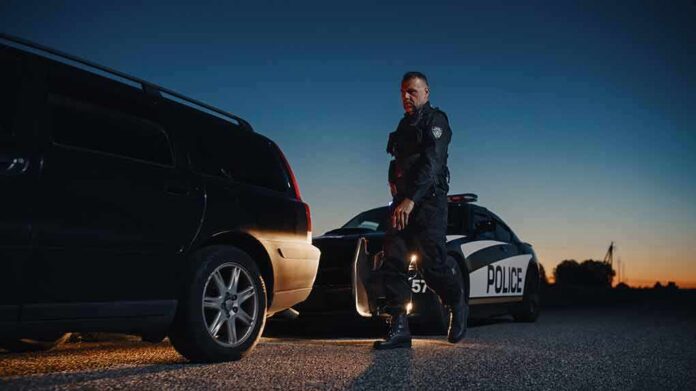
Drivers pulled over for speeding or a broken light often notice the officer pause and touch the rear of their car before walking up. This is not random. It is a routine step built into how many officers approach a stopped vehicle, meant to protect them and to leave proof they were there. The habit shows up in police training circles across many states.
Nick Fresolone, a retired instructor at the New Jersey State Police Academy, explains the move leaves a fingerprint on the taillight glass. If the stop turns violent or the driver flees, that print proves the officer made contact with that exact car at that exact time and place.
A Police Union Leader Backs Up The Claim
William Johnson, who leads the National Association of Police Organizations, told fact-checkers the practice is real. Officers do touch taillights and other spots on the back of a car on purpose, he said, calling it a simple but useful safety habit that costs nothing and takes only a second to do.
Before dash cameras and body cameras became standard gear, a fingerprint on glass was one of the few ways to show an officer had truly been at a car. Even now, with cameras rolling on most stops, many departments still teach or pass down the tap as an extra layer of proof and habit.
Safety Checks Happen At The Same Time
The touch does more than leave a print. Officers use the moment to glance at the trunk and make sure it is fully closed, since an open trunk can hide a person or a weapon. A guide focused on officer safety during stops lists this kind of quick visual and physical check as one of several tactics used in the early moments of an approach.
A separate breakdown of the practice notes officers may also use the touch to check for tampering, such as a taillight that looks broken or wired wrong, which can signal a bigger problem with the vehicle.
The Touch Can Also Mark A Moment Of Contact
Some explanations focus less on evidence and more on timing. Touching the car creates a clear point when the officer and driver both know contact has been made, before any conversation starts. One writeup describes it as a physical checkpoint that confirms the driver has not fled since being pulled over, right before the officer reaches the window.
Other accounts describe the tap as a way to briefly startle a driver, giving the officer a second to watch how someone reacts before speaking. This is described alongside the fingerprint reason, not instead of it, in several explainers on the topic.
A Routine Step Drivers Rarely Question
For most drivers, the tap on the taillight lasts a second and goes unnoticed. But it reflects a mix of habit, caution, and evidence-gathering built up over decades of roadside stops. Whether taught formally in every academy or passed down officer to officer, the practice remains common enough that police unions and training veterans openly describe why it happens.
The next time a driver sees flashing lights and feels an officer’s hand brush the back of the car, it is worth remembering the gesture carries real purpose. It is a small piece of a much larger playbook built around officer safety and accountability during one of the most unpredictable moments in everyday policing.
Sources:
carparts.com, threebrosauto.com, youtube.com, police1.com, dailymail.co.uk, thelawdictionary.org
© conservativesense.com 2026. All rights reserved.