

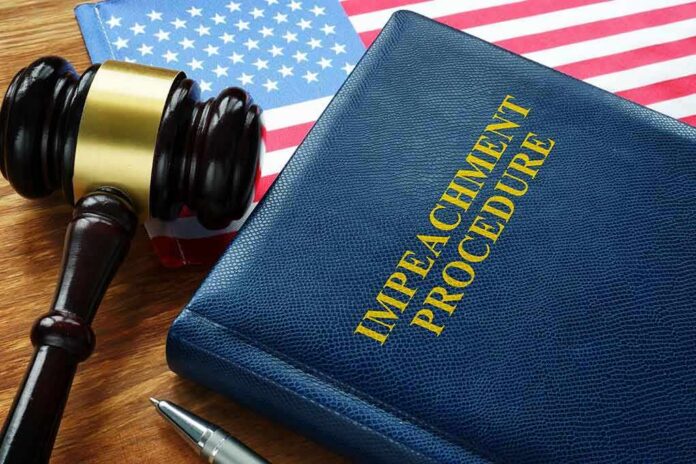
Steve Scalise is telling voters that a Democratic House would move to impeach President Trump on “day one,” raising the stakes for turnout this November.
Story Snapshot
- House Majority Leader Steve Scalise warns Democrats would impeach Trump immediately if they win the House.
- Scalise’s message echoes years of GOP claims that Democrats abused impeachment in 2019–2021.
- Some Democrats signal a focus on investigations over instant impeachment if they regain power.
- The Constitution makes impeachment a political process shaped by party control and incentives.
What Scalise Said And Why It Matters Now
House Majority Leader Steve Scalise said Democrats “will impeach the president day one” if they take back the House in November, urging Republicans not to sit out the election. He has tied past impeachment drives to what he calls partisan abuse, pointing to the 2019 process as a “vendetta” that denied due process. His argument is simple: control of the House sets the agenda. If Democrats win the gavel, they decide what gets investigated and what gets a vote.
Scalise’s warning lands in a country tired of power games. Many Americans on both the right and the left think Washington protects the well-connected first and serves families last. For them, another impeachment fight would feel like more theater while prices, health costs, and border chaos remain unsolved. Scalise is tapping that frustration. He frames impeachment as proof that elites ignore real problems and use Congress to attack political enemies instead of fixing daily life.
What Democrats Say They Would Do If They Win
Democratic leaders have sent mixed signals. Some public comments and reporting say Democrats are not focused on impeaching Trump “at the moment,” while aides describe plans to prioritize broad investigations if they regain the House, not an immediate vote to impeach. These accounts suggest an oversight-first approach to the administration and related businesses. That pathway still carries risk of fast escalation, since investigations can surface claims that lead to formal charges.
Recent history shows how quickly the ground can shift. In 2019, the House launched an inquiry and marched toward votes along party lines. The process moved at political speed, not court speed. That is the point Scalise stresses: when one party runs the House, the majority sets the clock and the tone. Voters who dislike endless probes may see little difference between a day-one impeachment and a months-long investigation that ends at the same place.
Impeachment’s Rules And The Power Of The Majority
The Constitution gives the House the sole power to impeach and the Senate the sole power to try cases. There is no fixed legal burden of proof like in criminal trials. Members decide for themselves what counts as “high crimes and misdemeanors” and when to act. That design makes impeachment a political tool as much as a legal step. When a majority believes action is justified—or useful—it can move quickly. When it does not, it can stall or stop.
🚨 THE MIDTERM STAKES: DEMOCRATS ARE PREPARING FOR MAJOR TRUMP INVESTIGATIONS IF THEY WIN THE HOUSE
House Democratic leaders are already discussing how they would use a new House majority to investigate President Donald Trump, his administration and members of his family — and… pic.twitter.com/voOzHqo68B
— JoSweet 🇺🇸🐊 (@Molnar_Politico) September 14, 2026
This structure explains the cycle we see today. Each side cites the other’s past moves to justify its own plans. Scalise argues Democrats normalized impeachment against Trump before and would do it again if voters hand them power. Democrats argue oversight is necessary because no president is above the law, and investigations are part of Congress’s duty. Both positions are possible under the same rules. The difference is who holds the votes after November.
Sources:
youtube.com, scalise.house.gov, cbsaustin.com, usnews.com, congress.gov
© conservativesense.com 2026. All rights reserved.