
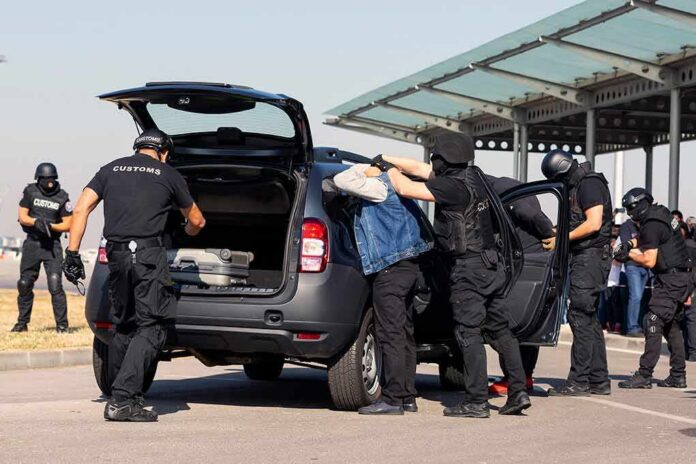
A federal immigration officer shot a man in North Austin, and the city moved fast to confirm it and demand answers.
Story Snapshot
- City officials confirmed a federal immigration officer fired the shot; Austin police did not.
- The wounded man was taken to a trauma center in serious but stable condition.
- Protesters blocked roads near the scene as night fell and tensions rose.
- City leaders called for an independent, co-equal investigation into what led to the gunfire.
City Confirms Who Fired And Who Did Not
A federal immigration officer fired on a man in North Austin near U.S. 183 and Anderson Square on Sunday, according to Austin officials. Mayor Kirk Watson and Police Chief Lisa Davis said the shooting involved a federal immigration officer and not an Austin police officer. The city said information was early and urged patience as facts develop. The officials’ quick confirmation set the frame for a tense night on a busy stretch of roadway.
Local reporting described a stop that turned into a brief foot pursuit before the shot was fired. Authorities did not release what led to the stop or why force was used. The lack of detail, paired with the city’s clear statement that Austin police did not shoot, made two points true at once: the government confirmed who pulled the trigger, and it had not yet said why it happened. That mix often drives public pressure for a fuller record.
The Victim’s Condition And The Emergency Response
Medics took the wounded man to a nearby trauma center after he was shot in the torso. City officials described his condition as serious but stable. That update spread fast and fueled concern at the scene. The clear medical status, shared by multiple outlets, urged both caution and urgency. It told people he was alive and receiving care, and it signaled that this was not a minor incident anyone could shrug off and move past by the next news cycle.
The city did not release the man’s identity. Some reports pointed to a name via an attorney, but officials did not confirm it in their briefings. Without a confirmed identity or public record of his exact role in the stop, the conversation on the ground focused on process: who investigates, who gets access, and how any use of force gets reviewed. That is the right focus in a country that values both law and accountability.
Protesters Fill The Streets And Force A Second Storyline
Hundreds gathered near the scene by evening, chanting against the federal immigration agency, holding signs, and blocking lanes. Police declared an unlawful assembly after traffic snarled and tempers rose. Crowd-control measures followed at points as officers cleared blocked roads. The marchers insisted the city push for full transparency, while drivers trapped in gridlock wanted order restored. Both demands hit at core civic values: safety, clear rules, and evenhanded justice.
Anti-ICE Protesters Arrested After Austin Shooting
Dozens of protesters gathered in North Austin after an ICE agent shot and wounded 28-year-old Venezuelan Wilber Rafael Garces Perez during a Sunday traffic stop and foot pursuit.
The shooting remains under investigation, with…
— TWT UNLEASHED (@TWT_UNLEASHED) September 21, 2026
The protest energy locked in after city leaders asked for a third-party look at the shooting. The Travis County District Attorney’s Office asked to serve as a co-equal partner with Austin police in the probe. Mayor Watson said the city deserved answers and a clear review. That request took aim at a common gap in cross-agency cases: local leaders owe the public clarity, but federal agencies often hold the key evidence at the start.
Accountability Demands Meet A Sparse Early Record
Officials declined to say what prompted the stop, whether the man had a weapon, or how many shots were fired. Reports also flagged claims that officials could not confirm, such as whether he was shot in the back. City leaders framed the information as preliminary and emphasized the need for an independent review. That direct ask shows a priority that fits American conservative values: limited but firm government power, transparent oversight, and a fair process for all sides.
The next steps are simple to name and hard to execute. Investigators will look for body-camera, dash-camera, and surveillance video from every agency that was present. They will pull dispatch audio and computer-aided dispatch logs to build a minute-by-minute map. They will gather officer statements, medical records, and scene evidence to track bullet path and firing distance. If done right, the timeline will tell a clean story the public can test against the rules for use of force.
Why This Incident Became A Test Of Process
Local and federal roles often collide when a federal officer uses force in a city street. The public expects the same rapid clarity it sees after a city shooting. But federal cases can move slower and share less, especially early on. That mismatch does not excuse delay, and it does not prove wrongdoing. It does explain why crowds show up with signs and why mayors step to microphones to demand a seat at the table.
City officials did one thing right straight away: they told people what they knew for sure and asked for independent eyes on the rest. That posture lets the facts lead and keeps space for both order and dissent. The protests, while disruptive, kept a hard question in view: what happened in those final seconds before the shot? A careful, co-equal investigation can answer it. The city promised to push for exactly that outcome.
Sources:
redstate.com, latimes.com, kxan.com, trtworld.com, goodmorningamerica.com, texastribune.org
© conservativesense.com 2026. All rights reserved.