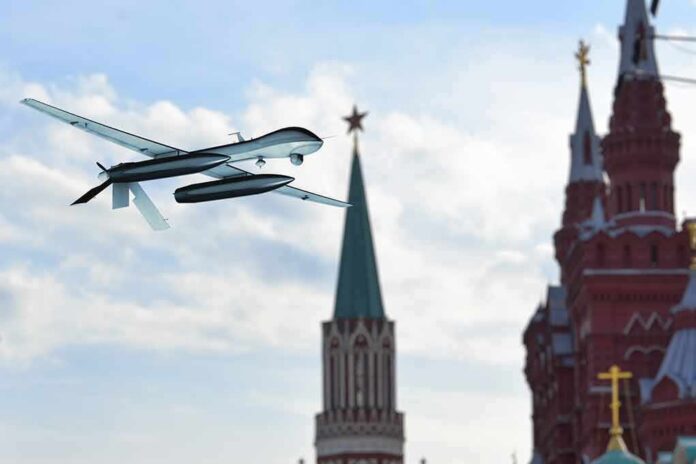
Hundreds of drones swarmed the Moscow region overnight, killing two people and igniting an oil refinery, according to Russian officials.
Story Snapshot
- Russian officials reported hundreds of drones targeted Moscow and nearby areas.
- Two people died in the wider Moscow region, with evacuations reported.
- Moscow’s mayor said air defenses downed large numbers near the capital.
- An oil refinery in Moscow sustained damage amid the attacks.
Overnight Drone Barrage Hit Moscow And Its Region
Russian authorities said a massive drone wave struck Moscow and surrounding districts overnight into Sunday. Officials reported two deaths in the wider region and damage at an oil refinery inside the capital. Moscow Mayor Sergei Sobyanin said city air defenses intercepted many inbound drones, while the regional governor reported more were downed across outlying districts. Reuters also reported deaths in the Moscow region and a hit on a refinery inside the city, citing Russian authorities.
Local leaders described broad disruption. The Moscow region governor reported injuries and evacuations after the strikes, as emergency crews worked through the night. Officials emphasized the scale of the attack and the number of interceptions. Such tallies often vary across agencies during fast-moving events, but the through-line here is clear: a large drone wave reached the capital’s airspace and the surrounding belt, with lethal fallout on the ground.
Refinery Damage Underscored Strategic Aims
The reported refinery damage fits the larger pattern of long-range strikes on energy infrastructure during this war. Russian officials said a facility at the Moscow Oil Refinery was hit during the overnight attacks. Strikes on oil facilities carry both military and economic effects. They can limit fuel supply, force costly repairs, and strain local emergency services. Even if air defenses down many drones, a handful that leak through can still light a vital node and create hours of smoke, heat, and risk.
The choice to hit fuel infrastructure near a major city also sends a clear message. It reminds residents and leaders that distance is not safety, and that layered air defenses can be saturated. Analysts have noted repeated swings in claimed interception counts in past incidents around Moscow. The debate tends to be about how many drones got through, not whether the strike happened. That is the nature of mass, low-cost systems: quantity becomes a tactic, stress-testing radars, launchers, and crews.
Casualties And Civil Impact In The Moscow Region
Officials reported two people killed in the Moscow region during the overnight attacks. Russian media and wire services described additional injuries and evacuees as debris and impacts hit homes and facilities. The civilian toll appears limited compared to the claimed drone count, but that does not make the risk small. Falling fragments from interceptions can wound bystanders, ignite secondary fires, and damage power lines or gas infrastructure. Urban sprawl means even debris fields can be deadly.
Authorities moved to contain the fires and assess structural damage at the refinery and other sites. Emergency teams often face a second wave of hazards after the initial strikes: smoldering tankage, unstable roofs, and unexploded parts. Rapid damage control can reduce the chance of cascading outages. The real cost often appears later, in refinery downtime, traffic dislocation, and the drain on municipal budgets already stretched by repeated alerts.
What The Attack Says About Modern Air Defense
Large drone swarms try to beat defenses with numbers, angles, and timing. Even strong systems can run low on ready missiles or operator bandwidth when dozens of small targets arrive at once. Russian officials have, in prior episodes, reported very high intercept totals during single nights across multiple regions. Independent outlets and observers frequently highlight gaps between those tallies and visible damage, but the consistent point is that some drones keep getting through.
President Zelensky confirms Ukraine launched a massive drone attack on Russia, targeting a major oil refinery among other sites in Moscow region pic.twitter.com/pwoK6lA1t4
— KolHaolam (@KolHaolam) September 20, 2026
This kind of strike pressures leaders in three ways. First, it forces more air defense assets to guard cities instead of the front. Second, it diverts funds toward point defense of oil and power sites. Third, it shapes public mood by showing that key infrastructure can burn. From a common-sense standpoint, a country must shield its people, protect fuel hubs, and tell the truth about risk. Clear facts build trust. Spin cannot put out a refinery fire.
Sources:
© conservativesense.com 2026. All rights reserved.