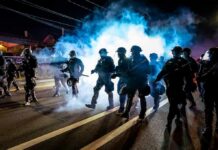


When mass urban unrest erupts, the rush to name a single cause is irresistible—and usually wrong. The French riots that prompted President Trump to blame immigration fit a well-studied pattern: layered triggers and structural vulnerabilities, not a monocausal story. Immigration can intersect with those layers; the evidence on this episode does not show it as the primary driver.
The Short Version
- President Trump explicitly and repeatedly attributed France’s unrest to immigration and urged border closure.
- Authoritative reporting and French officials described protests rooted in schools, cost of living, and public services, with violence attributed to far-left groups and looters.
- No verified demographic or offender data ties the bulk of the violence to immigrants or a religious community in this episode.
- France’s history shows causal layering in riots: immediate sparks plus segregation, deprivation, policing, and youth concentration—sometimes correlated with immigration, but not reducible to it.
What Trump said—and why it resonated
President Trump framed the French disorder as the consequence of immigration policy and urged leaders to “Close your Borders and take control.” He did so in contemporaneous, categorical terms and reiterated the point across multiple statements. The rhetoric was designed to be causal, not merely descriptive: immigration as the driver, everything else as pretext. That clarity—border control as solution to urban disorder—travels well in politics because it supplies an identifiable lever to pull. But clarity is not the same as proof, and policy levers should be judged against the full record, not the adrenaline of a viral weekend post.
For the claim to stand as explanation rather than slogan, two things are needed: mechanism and evidence. Mechanism means specifying how recent migration flows translate into the observed behaviors—arson patterns, target selection, coordination, geographic spread. Evidence means arrest demographics, charging data, and credible attribution from police or courts. In this episode, neither was made public at the time Trump advanced his claim. Meanwhile, core facts about the unrest itself—arson, looting, government buildings attacked, and mass arrests—are established in mainstream reporting and make the search for causes more than academic.
What French officials and reporting actually documented
French authorities drew a sharp line between large, largely peaceful demonstrations and violent actors who hijacked them. President Emmanuel Macron and the Interior Ministry described demonstrators airing “legitimate demands” about living costs, fuel prices, and public services—schools foremost—while attributing violence to radical far-left elements and criminals intent on confronting police and looting. This is not a semantic dodge; it is the official investigative lens that guides resourcing and prosecutions. Notably, those same officials did not link the unrest to immigrants as a class.
Independent reporting aligns with that institutional account of origins: protests began among high-school students in economically disadvantaged suburbs over teacher shortages and deteriorating facilities, then broadened to inequality and public-spending concerns. That chronology matters because narratives of causation nearly always follow the fuse; when the first grievances are institutional and socioeconomic, a later claim that the crisis is “not about schools” bears the burden of disproving the documented sequence.
Where the claim collides with the evidence
Two issues undercut the immigration-blame thesis in this episode. First, the absence of verified offender demographics. Assertions about who filled the streets—“predominantly” this or that group—remain assertions without police or court data. High-volume arrests, however dramatic, are not a demographic ledger; neither are decontextualized flag sightings. Without a dataset on nationality, immigration status, age, and residence of arrestees, claims about immigrant responsibility are not falsifiable, but they are also not proven.
Second, attribution from competent authorities. French police and ministers publicly named radical-left organizers and opportunistic looters as principal violent actors; they did not present immigration as the causal frame. Journalistic syntheses cited those same institutional views and the protests’ social-policy roots. A contrary claim from a political leader abroad does not outweigh on-the-record domestic attributions unless it brings specific corroboration—intelligence, court filings, or arrest analyses that French counterparts missed or concealed. That corroboration has not surfaced in the material at hand.
How riots actually work in France: the layered model
France’s modern riot literature is strikingly consistent on one point: causal layering. Immediate triggers—often police encounters or discrete local shocks—interact with neighborhood segregation, youth concentration, unemployment, perceived discrimination, and institutional distrust. Immigration can be part of that ecology, usually as a correlating characteristic of segregated suburbs rather than a sufficient or necessary cause. Studies of the 2005 unrest and subsequent waves find greater incidence where deprivation and segregation are high, with some associations to immigrant share; the mechanism runs through exclusion, opportunity structures, and policing patterns, not mere foreign-born status.
This matters for policy. If immigrant share correlates with minor unrest odds—as one recent working paper suggests—then interventions that target segregation, schooling quality, and labor-market access may reduce risk independent of changes to legal immigration levels. Immigration restriction alone would miss the levers that the French evidence base associates with riot propensity: concentrated youth, illiteracy proxies, and stigmatized housing estates. Conversely, dismissing immigration as irrelevant ignores its role in shaping the demography of the very neighborhoods where exclusion concentrates. The layered model rejects both oversimplifications.
#Watch | France has imposed overnight curfews in parts of Paris on October 19 following violent protests, looting and clashes with police over the rising cost of living. Restrictions have also been introduced for minors in several French cities.
Meanwhile, U.S. President Donald… pic.twitter.com/j9XbkFpuh4
— The Hindu (@the_hindu) October 20, 2026
What would a convincing immigration-causation case require?
Serious claims can be tested. The evidentiary bar is not mystical; it is administrative. Start with an incident-level dataset from the Interior Ministry and prosecutors: alleged offense, location, age, nationality, immigration status, and eventual case disposition for each arrestee. Add geospatial overlays—immigrant population share, recent migration flows, unemployment, school quality, and policing levels—then pre-register models that predict riot intensity by commune. Finally, incorporate primary-source motive statements from organizers and defendants. If immigration is the driver, it will show up as a robust, plausibly causal coefficient that survives controls for deprivation, youth share, and institutional variables. In this episode, that package does not exist in public view.
Judgment and implications
Trump’s diagnosis is clear and politically salient; it is not substantiated by case-specific evidence here. The best-supported account of the unrest’s origins emphasizes schools, cost-of-living pressures, and deteriorating public services, with violent escalation attributed to radical-left actors and criminal opportunists by French authorities. France’s longer record shows how immigration can correlate with riot risk through segregation and exclusion, but correlation in prior episodes is not proof of causation in this one. Causal layering remains the most credible model—and the most useful for policy—because it matches both the chronology on the ground and the comparative literature.
Sources:
youtube.com, trumpstruth.org, straitstimes.com, yahoo.com, ynetnews.com, biz.heraldcorp.com, timesofisrael.com, aol.co.uk, democracynow.org, rte.ie, wionews.com, news.meaww.com, sciencedirect.com
© conservativesense.com 2026. All rights reserved.