
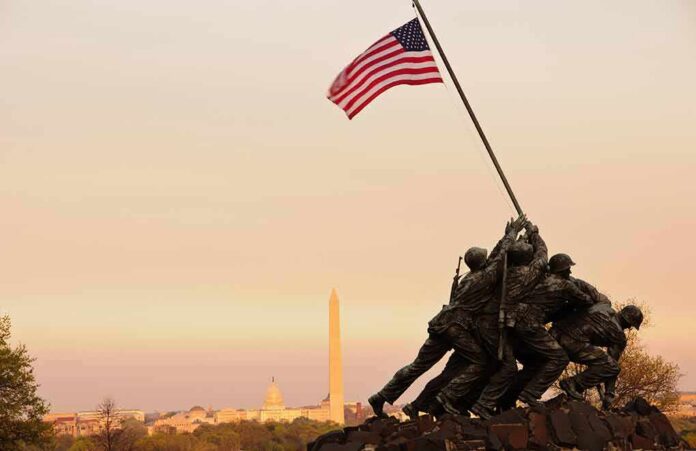
Police say they caught a man in the act of beheading a Marine figure on the Iwo Jima monument with a sledgehammer in Quantico.
Story Snapshot
- Officers say they found a suspect striking the monument with a sledgehammer.
- The arrest happened at the scene near Richmond Highway and Fuller Road.
- One Marine figure’s head was reportedly knocked off the statue.
- Police listed three charges, including felony injury to a monument.
Police say they interrupted an active attack on a war memorial
Prince William County Police reported that officers arrived around 10:13 p.m. on October 21 near Richmond Highway and Fuller Road in Quantico and found a man actively swinging a sledgehammer at the Iwo Jima monument. The officers detained the suspect, identified as 27-year-old Miguel Alonso Maldonado Soriano of Stafford, without incident at the scene. The location sits near Marine Corps Base Quantico, home to one of the nation’s most significant military communities and training grounds.
Police accounts published by several local outlets align on time, place, and sequence. Reporters described a rapid response, an on-scene arrest, and immediate linkage between the suspect and the damaged statue. Local coverage based on the police statement says the alleged vandalism focused on the figures that honor Marines who raised the flag on Mount Suribachi in World War II. The monument stands as a public symbol of sacrifice, grit, and the cost that victory demanded from young Americans.
Charges name specific crimes tied to monuments and property
Police listed three charges: felony destruction of property, trespass with intent to damage property, and felony injury to a monument. This charging mix shows a focus on both the act and the protected status of the target. The alleged use of a heavy tool, a sledgehammer, supports the choice of felony counts. Prosecutors often use monument-specific statutes when the object holds cultural or historical value that makes the damage more than routine vandalism.
Reporters noted that one Marine figure’s head was knocked off during the attack, a clear injury to a symbol that matters to veterans, families, and the wider public. Some outlets cited an estimated damage range in the hundreds of thousands of dollars, though police accounts did not name a valuation method or a repair plan in the early reports. A court date was pending at the time of reporting, and any verdict will come later in the process.
Why this target hits a national nerve
The monument depicts the famous scene from Iwo Jima, where Marines fought through brutal combat to raise the flag and signal a turning point in the Pacific. Americans see those figures as stand-ins for service and honor, not just stone or metal. When someone swings a sledgehammer at that image, people read it as an attack on the values behind it. That response is not partisan; it is common sense shaped by history shared across generations.
Vandal beheads Quantico Iwo Jima statue soldier with sledgehammer, causing over $100K in damage🤬
Man Arrested After Using Sledgehammer to Behead Marine on Quantico Iwo Jima Statue, Causing Hundreds of Thousands in Damage
On the night of Wednesday, October 21, 2026, around… pic.twitter.com/Q4tOYiCQqU— Star S.⭐️⭐️⭐️⭐️⭐️ (@DominguezH31015) October 23, 2026
Local authorities treat damage to memorials as cultural-property crime, which is part of a broader pattern where destruction, not theft, leads the offense type. International data sets often show that trend. For example, Polish police recorded 67 heritage crimes in 2024, with about three-quarters involving destruction or damage to protected monuments rather than theft or export, a pattern that mirrors what communities feel on the ground when symbols are struck.
What comes next: restoration, accountability, and deterrence
Restoring a damaged monument usually starts with stabilization, detailed condition mapping, and a conservation plan. A head sheared from a figure often requires structural pinning, custom casting, or re-carving, and careful surface matching. Insurance claims, public funds, or donations can underwrite that work. Courts will address accountability. If the facts in the police report hold up, the charges fit the act. That aligns with conservative values that protect public heritage, punish willful damage, and deter repeat attacks.
Local leaders can use this case to tighten after-hours security around high-profile memorials. Simple changes matter: better lighting, timed patrols, and discreet sensors that alert officers before heavy damage occurs. Communities can also rally volunteers to help monitor sites and support quick repairs. These steps honor the people the monument represents and send a clear message: you do not get to rewrite history with a hammer.
Sources:
fox5dc.com, princewilliamtimes.com, insidenova.com, potomaclocal.com, washingtontimes.com, washingtonexaminer.com
© conservativesense.com 2026. All rights reserved.