

The headline framing is the least trustworthy part of this story; the underlying number is the most solid part — and understanding why those two things can both be true is the whole lesson here.
Key Points
- Michigan’s own environmental agency, not outside activists, produced the estimate that roughly 75% of the state’s rivers and streams likely exceed fecal-contamination limits.
- The figure is a statistical extrapolation from about 367 monitored sites covering roughly half the state’s waterways, not a direct census of every river mile.
- E. coli is used as an indicator of fecal pollution, not a measurement of a specific pathogen or a proven illness count.
- Contamination sources are distributed across sewer overflows, failing septic systems, and farm manure runoff — a problem decades in the making, not a single administration’s creation.
- Michigan faces an estimated $15–40 billion water-infrastructure funding gap, which explains why remediation lags even where the problem is well documented.
What the state’s own data actually shows
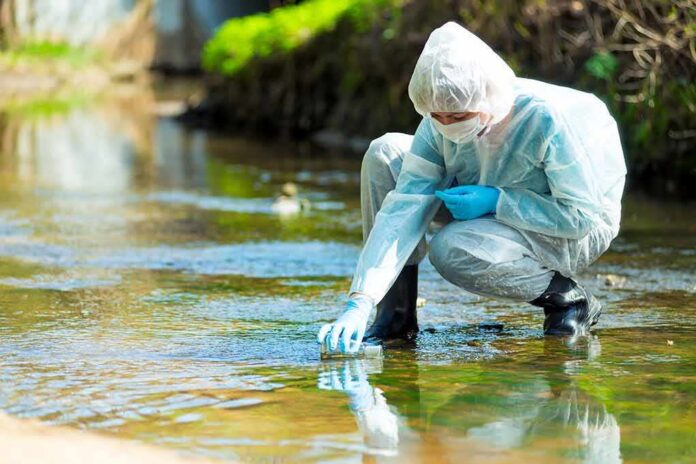
Molly Rippke, who runs E. coli testing for Michigan’s Department of Environment, Great Lakes, and Energy (EGLE), told the Associated Press that results compiled so far indicate approximately 75% of Michigan rivers and streams likely exceed state fecal-contamination limits, a statement published November 19, 2026. That estimate rests on EGLE’s draft 2026 Integrated Report, which compiled E. coli data from 367 monitoring sites statewide, including roughly 257 selected through a probabilistic design meant to represent conditions across the broader river network rather than just known trouble spots. This is a meaningful distinction: the number did not originate from a partisan talking point or an activist press release. It originated from the agency charged with enforcing Michigan’s own water-quality law, using its own sampling protocol, published in its own compliance report to the EPA.
The recreational-safety stakes are concrete, not abstract. Michigan’s swimming standard is exceeded when a single sample tops 300 E. coli organisms per 100 milliliters, or when the 30-day running average exceeds 130; the looser threshold covering paddling, wading, and fishing sits at 1,000 per 100 milliliters. AP’s reporting found the large majority of tested waterways exceeded the swim standard, and more than half failed even the looser partial-contact threshold. That second figure is the more alarming one for anyone who assumes a river is “probably fine” as long as they’re not swimming in it — a kayaker or a kid wading after fish bait is still, in a majority of tested locations, wading through water the state itself classifies as unsafe for that activity.
Why “75% contaminated” is not the same as “every river, all the time”
Here is where the sensational framing overreaches the evidence. The 75% figure is an estimate drawn from roughly half of Michigan’s rivers and tributaries that have actually been tested; it is extrapolated, not exhaustive. Rippke herself cautioned that exceeding the threshold doesn’t mean a waterway is perpetually polluted — water quality fluctuates with rainfall, season, and upstream activity, and most Michigan waterways are not sampled routinely enough to characterize that variation precisely. And E. coli itself is a proxy, not a diagnosis: it’s the indicator organism regulators use under the Clean Water Act because it’s cheap and reliable to test for, standing in for the harder-to-detect pathogens — giardia, cholera-causing bacteria, viruses — that actually make people sick. A high E. coli reading tells you fecal material is present and the statistical odds of illness rise; it does not, by itself, prove a specific outbreak or quantify a statewide disease burden. No such pathogen-linked epidemiological study accompanies the 2026 estimate.
A problem with many authors, spanning many administrations
The framing that attaches this contamination specifically to “Gretchen Whitmer’s Michigan” does not survive contact with the sourcing. The documented contributors are sewer overflows from aging municipal systems, leaking residential septic tanks numbering in the tens of thousands, and manure runoff from the state’s growing concentration of large-scale livestock operations. None of those causes trace to a single governor’s decision; they trace to infrastructure built, and allowed to age, across generations of state leadership, and to a regulatory apparatus — the statewide E. coli Total Maximum Daily Load framework — that the EPA approved back in 2019 and that EGLE has continued to apply and expand through permit enforcement, corrective-action orders on illegal discharges, and voluntary partnerships with landowners and conservation districts. The deeper obstacle is money: Michigan communities face an estimated $15 billion in unfunded stormwater and wastewater needs over the next two decades by Bridge Michigan’s count, while a University of Michigan analysis puts the full statewide capital gap closer to $39.6 billion plus roughly $860 million in annual ongoing costs. That is a structural, multi-decade funding shortfall — the kind no single budget cycle or single administration closes.
Where genuine accountability questions remain open
None of this means the state gets a pass. Legislators “for years have done little as the problem got worse,” as Bridge Michigan’s investigation into repeated missed deadlines put it, and the Whitmer administration’s own $89 million “Reclaim the Rivers” commitment, announced in October 2026 for the Detroit and Kalamazoo rivers, concedes that remediation has lagged for decades on industrially contaminated waterways. The fair question is not whether contamination is real — EGLE’s own data says it is — but whether enforcement timelines, permit compliance, and infrastructure funding decisions under the current administration accelerated or merely managed a problem inherited from predecessors. The available public record does not yet contain the enforcement files, budget line items, or permit-compliance history needed to settle that question either way. What it does contain is a credible, agency-generated contamination estimate, a well-understood and multi-source set of causes, and a funding gap measured in tens of billions of dollars that no governor has closed yet.
Pure Michigan has a poop problem: Dangerous fecal levels befoul 3 of 4 rivers
Rachel Cuschieri-Murray loves the Grand River, which she calls a “precious gift.” The state’s longest river flows 252 miles from Hillsdale County, past farm fields…https://t.co/yWk6a8Ttaq pic.twitter.com/2CDZPH47CP— Blue Community .net (@BlueCommunity_N) November 20, 2026
What this means for anyone near the water
Practically, the lesson for Michigan residents is unglamorous but important: treat unposted, untested stretches of river with the same caution as posted ones, especially after heavy rain, when runoff spikes bacterial counts sharply; avoid submerging your head or ingesting water even during paddling and wading; and understand that the absence of a warning sign reflects an absence of monitoring as often as it reflects clean water. The state’s own mapping tools and TMDL framework exist precisely because this is a solvable, if expensive, engineering and regulatory problem — Bridge Michigan has documented rivers the state has successfully rehabilitated before. The real story is a decades-deep infrastructure deficit colliding with modern, more rigorous testing that finally shows its scale. That is worth public alarm. It does not require inventing a single villain to be worth taking seriously.
Sources:
thegatewaypundit.com, nbcchicago.com, the-independent.com, theoaklandpress.com, bridgemi.com, michigan.gov, thenewlede.org
© conservativesense.com 2026. All rights reserved.