
Nicki Minaj’s trip aboard Air Force One with President Trump and her onstage pledge of enduring support at a Michigan rally were not mere celebrity spectacle; they were a tightly coupled act of political signaling, logistical access, and message amplification that illustrates how contemporary campaigns fuse governing theater with cultural capital.
At a Glance
- Minaj traveled on Air Force One with President Trump to Michigan and disembarked with the presidential party at Selfridge Air National Guard Base.
- She appeared at Trump’s Port Huron rally, sharing the stage and delivering an explicit, personal statement of ongoing support.
- Minaj framed Trump positively and urged support for Republican candidates Mike Rogers and John James in Michigan.
- Her Air Force One access and rally presence were captured in contemporaneous reporting and visual material.
What Happened: Air Force One to the Port Huron Stage
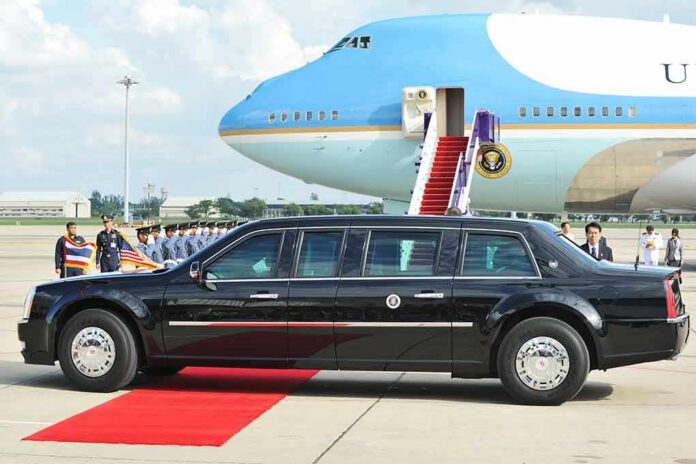
On October 25, 2026, Nicki Minaj accompanied President Trump aboard Air Force One to Michigan, where cameras captured her stepping off the aircraft at Selfridge Air National Guard Base before the Port Huron rally. Multiple outlets reported the shared flight and her presence in the president’s arrival party; coverage also identified images of her disembarking and referenced a video posted by White House Communications Director Steven Cheung showing Minaj aboard the aircraft. That evening, Minaj joined Trump at the Port Huron campaign rally. She was visible near the stage and then appeared with him, addressing the crowd and aligning herself with the president and the Republican ticket.
Minaj’s remarks were unambiguous. She told the audience it was an honor to stand with President Trump “every single time” and vowed to continue supporting him “forever and ever,” adding that she would back him again if he were to run in the future. She also urged support for Republican Senate candidate Mike Rogers and House candidate John James—localizing her endorsement to the ballot the rally was designed to energize. The political stagecraft was thus complete: presidential platform, celebrity surrogate, and targeted down-ballot appeals delivered in one media-saturated package.
Why It Resonated: Access, Optics, and Message Discipline
Traveling on Air Force One is a powerful image because it connotes presidential proximity and institutional stature. When a celebrity steps into that frame—literally inside the aircraft—the campaign message acquires a pop-cultural veneer that newsrooms and social feeds inevitably magnify. In this case, the sequence was crisp: a high-visibility arrival, an onstage appearance, and a direct testimonial. Visual corroboration and named-witness reporting reinforced the travel narrative; Cheung’s video interview with Minaj aboard the aircraft, referenced in press accounts, further anchored the claim in identifiable material. The choreography—arrival shot, rally camera, onstage microphone—created a verifiable trail of the day’s movements and statements.
At the rally, Trump’s own commentary on Minaj’s appearance, widely quoted in coverage, competed for attention with her endorsement. That is an old pattern in political communication: a candidate’s colorful aside can eclipse the surrogate’s message even as it expands the story’s reach. Yet the substance of Minaj’s remarks—and the sightline of supporter, candidate, and campaign targets—remained intact in the record. Her explicit pledge of continuing support, coupled with localized exhortations for Rogers and James, bound celebrity presence to electoral purpose.
Mechanics and Precedent: How Campaigns Use Celebrity Capital
Campaigns enlist celebrities for three reasons: audience reach, perceived credibility with specific demographics, and content that travels. The Air Force One vignette offered all three. The aircraft delivers unmatched visuals; Minaj brings a global fan base; the rally supplies narrative arc and quotes. Whether such moments change votes is a separate question. The academic literature on celebrity endorsements is mixed. One well-known analysis of Oprah Winfrey’s 2008 endorsement of Barack Obama estimated a sizable bump in primary support and small-donor engagement; other experimental studies find minimal or contingent effects on vote intention and candidate evaluation, sometimes with backlash among out-groups.
In other words, celebrity appearances are reliable at generating attention; their translation into persuasion depends on audience fit, endorser credibility, and issue alignment. Minaj’s message here was personal and durable—“forever and ever”—and attached to concrete targets (Rogers and James), which is generally how campaigns try to convert fame into field advantage: move talk to turnout by naming the race and the candidate.
Governance vs. Campaigning: The Line Around Presidential Travel
When a sitting president travels for political events, cost allocation and access rules are governed by longstanding practice: official business is borne by the government; campaign or political activity triggers reimbursements by the relevant political committee under federal guidelines. While the details of any specific trip’s accounting rest with the White House and party committees, the underlying framework is clear and routinized in modern presidencies. Against that backdrop, Minaj’s appearance aboard Air Force One functioned as a political optic nested within a standard travel regime—an optic that campaigns value precisely because it blends the trappings of office with partisan mobilization.
The access question is thus less about novelty and more about intent: who the guest helps reach, what messages they deliver, and how coverage ricochets across platforms. Minaj’s participation checked all three boxes. The convergence of presidential imagery, celebrity endorsement, and targeted state-level appeals is not accidental choreography; it is the playbook.
Nicki Minaj urged Michigan voters to “vote red” at a Trump rally, while a viral post claims she can’t vote. She said in 2024 she isn’t a US citizen, and later said she was finalising citizenship paperwork, but her current status isn’t confirmed.https://t.co/iPzvdnlAYD
— Bernadette B. Tixon (@tixie_avis) October 27, 2026
What It Means: Durable Signal, Variable Electoral Yield
As a matter of fact pattern, the sequence is settled: Minaj flew with President Trump to Michigan, appeared at his Port Huron rally, endorsed him in emphatic personal terms, and pressed for Republican wins on the state’s ballot. As political currency, the moment’s value lies in its replay. Clips of her arrival and onstage remarks will circulate longer than any single news cycle; they give the campaign re-usable assets for fundraising emails, microtargeted ads, and turnout scripts keyed to constituencies Minaj reaches organically.
Whether that translates to measurable vote shifts is unknowable in isolation and, historically, inconsistent. Some endorsements have demonstrable impact when the celebrity’s credibility and audience alignment are unusually strong; many are better understood as enthusiasm and attention engines, feeding fundraising, volunteer recruitment, and media tempo rather than ballot conversion. Even on that narrower metric, this appearance delivered: crisp visuals, quotable lines, and local candidate mentions—all the ingredients campaigns need to push supporters from awareness to action.
Sources:
facebook.com, bbc.com, people.com, cnn.com, globalnews.ca, fox10tv.com, academic.oup.com, ideas.repec.org
© conservativesense.com 2026. All rights reserved.