

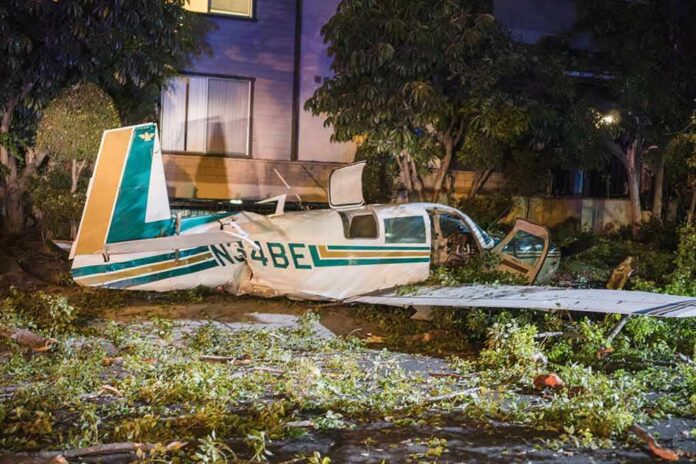
Survival in small-aircraft crashes is rarely accidental; it’s a compound of aeronautical judgment, energy management, and a little luck with the terrain. A North Carolina couple and their two dogs walked away because a powerless Piper was flown all the way to the crash—into trees that bled off energy—rather than surrendered to uncontrolled descent.
At a Glance
- A single-engine Piper PA-32 lost power en route from Hickory to Ocean Isle Beach and came to rest in trees; the pilot, his wife, and their two dogs survived with minor injuries.
- The pilot reported the engine “wasn’t producing power,” and the FAA confirmed the flight experienced mechanical issues before contacting trees.
- The aircraft’s energy was dissipated by trees, not by a direct ground impact—an outcome described consistently across local outlets.
- Powerplant problems are a leading general-aviation accident factor; “engine failure” spans multiple mechanisms from component failure to fuel issues.
What Happened: A Power Loss, a Forced Landing, and a Survivable Outcome
On October 7, 2026, a single-engine Piper PA-32 carrying pilot Dustin Davis, his wife Autumn, and their dogs departed Hickory Regional Airport bound for Ocean Isle Beach. En route over eastern North Carolina, Davis reported a loss of engine power and maneuvered toward lower terrain, ultimately contacting trees that brought the aircraft to a stop above the ground. Both adults sustained minor injuries and the dogs were unharmed, according to local reporting and on-scene accounts. The Federal Aviation Administration indicated the aircraft experienced mechanical issues prior to the treetop impact, aligning with Davis’s description that the engine “wasn’t producing power.”
Accounts from the cockpit are consistent on a key point: this was a controlled forced landing into trees rather than an uncontrolled crash into terrain. Davis told reporters the airplane missed smaller trees before striking a larger one that arrested the descent; another outlet described initial contact with a smaller, flexible tree that left the airplane perched several feet off the ground. In either sequence, the outcome is the same—kinetic energy was shed incrementally by vegetation, a mechanism long recognized by accident investigators as improving survivability in off-airport landings when a clear field or runway is out of reach.
Flying the Airplane to the End: How Survivability Is Built in Flight
In piston singles, a partial or complete loss of power turns the aircraft into a glider with a modest glide ratio. The pilot’s priorities are immediate: establish best glide speed to preserve energy, pick a landing area within reach, and configure the airplane to arrive under control. Where runways or roads are unavailable, trees—counterintuitively—can be preferable to fields with hidden ditches or powerlines. Branches fail progressively, shedding speed before the fuselage meets a larger trunk or the forest floor. Post-crash survivability hinges on three things: keeping the wings level at touchdown, minimizing vertical speed, and preventing post-impact fire. This event checks those boxes: controlled flight to impact, treetop energy dissipation, and no reported fire.
The PA-32, a heavy-hauling, low-wing single, offers predictable glide performance if trimmed properly; that buys time for a checklist memory item or two—fuel selector, mixture, ignition—while setting up for the forced landing. While this incident’s precise checklist execution isn’t documented, the consistent outcome across reports signals disciplined energy management: the aircraft arrived slow, wings roughly level, and met compliant terrain rather than an abrupt obstacle.
Why Engines Go Quiet: “Failure” Is a Family of Causes
“The engine failed” is a useful headline and a poor diagnosis. In the general-aviation record, power loss often traces to one of several buckets: a mechanical break in the powerplant, fuel exhaustion, fuel starvation (fuel onboard but not reaching the engine), contamination, induction icing, or maintenance error. FAA and NTSB summaries repeatedly place power-system component failures among the top causal categories for accidents and fatal accidents, just behind loss of control and controlled flight into terrain in many datasets. A broad FAA analysis of accident causal factors across tens of thousands of records underscores how recurrent—and varied—powerplant-related events are in personal flying.
That taxonomy matters for prevention. A fractured engine component has one set of mitigations—inspection intervals, compliance with service bulletins, oil analysis—while fuel mismanagement has another: fuel planning, tank-switch discipline, and strict adherence to checklists. Until investigators complete a powerplant and fuel-system examination, this case remains appropriately categorized as a power loss with mechanical issues indicated, rather than a pinned-down failure mode.
Pilot, wife and dogs survive dramatic tree-top crash landing after plane suffers engine failure: 'Just pray' https://t.co/hHmo9uw5f7 pic.twitter.com/fQa3RfBwBw
— New York Post (@nypost) October 23, 2026
Terminology, Consistency, and the Tree-Landing Pattern
Aviation language distinguishes between an emergency landing (a landing under abnormal conditions), a forced landing (no power, landing required), and a crash (loss of control or destructive impact). This event straddles terms: it was a forced landing that became a survivable crash as the aircraft came to rest in trees. The descriptive consistency across independent local outlets—power loss, controlled flight into trees, minor injuries—provides a coherent narrative of a “flown” outcome rather than a catastrophic loss of control.
Tree-contact survivals are not rare in the light-aircraft record. When pilots fly the airplane to the end—maintaining control, trading airspeed for margin near the surface, and keeping the fuselage aligned—the structure protects occupants remarkably well. The treetop arrest in this case, leaving the aircraft suspended several feet above the ground, is textbook energy management in hostile terrain and helps explain why both people and pets walked away.
What This Means for General Aviation Pilots and Passengers
Three lessons persist. First, power-loss scenarios reward immediate airspeed discipline; best glide is not a suggestion. Second, decision-making tempo matters. Turning a complex sky into a simple plan—pick a reachable landing area, configure, commit—preserves options. Third, practice is policy. Regular engine-out drills knit together memory items, flow checks, and sight pictures so that, when the propeller goes from noise to windmilling, the response is reflexive rather than improvised. The safety data show that while powerplant problems are a durable share of the accident landscape, a well-flown forced landing is often survivable.
Sources:
nypost.com, article.wn.com, m.dailyadvent.com, faa.gov, faasafety.gov
© conservativesense.com 2026. All rights reserved.