

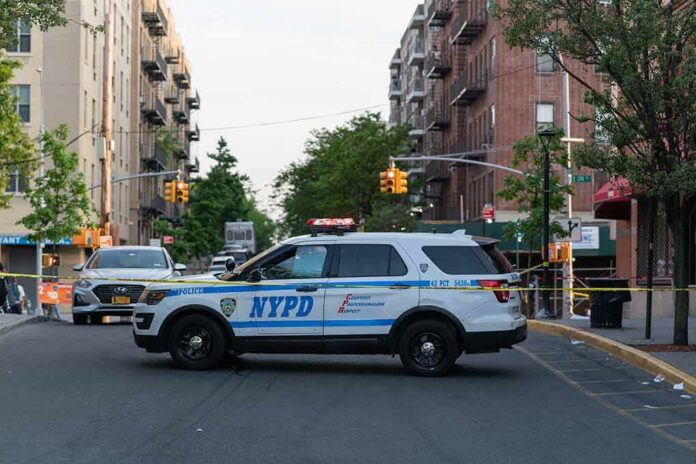
The clearest way to understand a violent street assault is to anchor it in what is known and then situate it in the environment that makes it legible; in Brooklyn, that means pairing concrete police actions and medical outcomes with a neighborhood pattern where antisemitic assaults are frequent but the hate-crime label is applied only when evidence meets a specific statutory threshold.
At a Glance
- Police arrested 31-year-old Eric Avrutov after a 66-year-old rabbi was struck on Dahill Road near Cortelyou Road in Brooklyn; charges include assault, criminal obstruction of breathing, and harassment.
- The attack, captured on neighborhood security video, lasted roughly 20 seconds; the rabbi was transported to Maimonides Medical Center in stable condition.
- NYPD said the case was not being investigated as a hate crime at the time; the same suspect allegedly punched a 60-year-old man at a nearby gas station minutes earlier.
- The incident occurred in a borough that has been a hotspot for antisemitic assaults, even as hate-crime designation hinges on strict statutory criteria and specific evidence.
What Happened And What Police Did
Contemporaneous reporting identifies Eric Avrutov, 31, as the individual arrested in connection with an evening assault on a 66-year-old rabbi in the Kensington/Borough Park area of Brooklyn. Police described a brief encounter around 9:20 p.m. on Dahill Road near Cortelyou Road: the assailant cornered the victim and struck him multiple times before fleeing. Officers apprehended Avrutov and charged him with assault, criminal obstruction of breathing, and harassment. The rabbi was taken to Maimonides Medical Center and listed in stable condition following treatment. The sequence, and the fact of an arrest with specific charges, is consistent across multiple outlets drawing on NYPD statements and neighborhood security video that captured the roughly 20-second attack.
Authorities also linked the incident to a second alleged assault minutes earlier: a 60-year-old man pumping gas nearby reported being punched without provocation. According to reporting that cites police, this earlier episode was handled as a separate assault-and-harassment case tied to the same suspect. The detail matters because it points to opportunistic street violence within a small geographic window, which can shape investigative posture regarding motive and charging choices as prosecutors assemble a docket.
How Hate-Crime Law Works — And Why This Case Wasn’t Labeled One At Intake
NYPD told reporters the rabbi’s assault was not being investigated as a hate crime at the time of initial coverage. That conclusion sits within a familiar legal framework: in New York, a hate crime isn’t a standalone offense but an enhancement applied when a specified underlying crime is committed because of a victim’s perceived or actual protected characteristic (such as religion), either by intentionally selecting the victim or being motivated in whole or substantial part by that perception. This standard appears in state guidance and police training materials; it requires indicia like bias statements, selection behavior, or other evidence of motive before the label attaches.
In practice, the threshold means two things. First, a visibly identifiable victim and a pattern of community targeting are not, by themselves, sufficient for prosecutors to plead a hate-crime enhancement; they need case-specific evidence. Second, intake language—“not being investigated as a hate crime at this time”—signals investigators did not have that evidence on the table at the initial stage, even as they preserved the ability to add or upgrade charges if facts emerge. The legal architecture is designed to prevent overextension of a consequential enhancement while preserving public-safety accountability through base charges that are easier to sustain on prompt facts.
Brooklyn’s Pattern: Frequent Antisemitic Assaults, Evidence-Dependent Labels
Context sharpens interpretation. Brooklyn remains one of the country’s most active hotspots for antisemitic incidents and assaults. ADL’s incident tracking shows Brooklyn accounting for a large share of statewide antisemitic assaults in recent reporting cycles; assaults in the borough rose substantially year-over-year, with Orthodox Jews disproportionately targeted in those events. City and state guidance underscores that even in places with elevated hostile activity, each case must satisfy the statutory elements for the hate-crime enhancement to apply. These two realities often collide in public perception: a community experiences a sustained pattern, but a given case may proceed initially without a hate-crime label because the specific evidentiary markers are absent or incomplete at intake.
This is not an academic distinction. The hate-crime enhancement affects penalties, public reporting, and resource allocation from specialized units; applying it prematurely can imperil a prosecution if motive evidence does not hold up, while applying it too late can signal institutional underestimation of bias harms. The operational compromise is to move forward quickly on base charges supported by video, eyewitness accounts, and medical findings, while continuing to screen for motive as interviews, digital forensics, and additional footage are gathered.
Mechanics Of The Case: Evidence, Charging, And Community Video
Reports reference neighborhood security footage distributed by local community-security organizations, showing the brief beating. Video like this often anchors probable cause and timeline reconstruction: frame-by-frame review can corroborate distance closed, number and direction of blows, and whether any verbal statements were made that microphones or adjacent cameras captured. In New York practice, prosecutors commonly pair such video with medical records from the receiving hospital to establish injury consistent with assault elements and with officer testimony to bridge custody and identification. In parallel, separate victims—in this case the gas-station patron—can provide statements that help establish pattern and sequence, even if their allegations proceed on their own charging instrument.
Initial charging with assault, criminal obstruction of breathing, and harassment reflects that mix: contact, injury or attempted injury, and conduct offensive enough to meet the harassment statute. Criminal obstruction of breathing—New York’s strangulation-adjacent offense—covers applying pressure to the throat or blocking nose/mouth; its presence on a charge sheet typically signals either witness description or medical indication of such conduct. Degree specifications and counts are formalized at arraignment and may change as prosecutors refine the theory of the case.
Eric Avrutov — charged with assault after allegedly beating a 66-year-old Brooklyn rabbi in an unprovoked attack outside his home, minutes after slugging a stranger at a gas station. Story: https://t.co/aFAsF8Yz45
— CancelPeople.com (@cancelpeoplenow) September 25, 2026
What This Means For Safety, Prosecution, And Public Discussion
Three practical implications follow. First, for public safety: swift arrest and hospital stabilization are the two immediate system outcomes that matter most in a street assault; both occurred here. Where community patrol footage exists, rapid dissemination to police shortens the investigative cycle and increases clearance odds. Second, for prosecution: base charges supported by clear video and medical evidence tend to be durable. If bias evidence materializes—through additional witness accounts, recovered audio, or digital communications—prosecutors can amend to add a hate-crime enhancement consistent with state law and agency guidance.
Third, for public discussion: Brooklyn’s elevated baseline of antisemitic assaults rightly sensitizes residents to the possibility of bias in any attack against a visibly Orthodox victim. That sensitivity coexists with a legal system that applies enhancements only when case-specific facts meet defined elements. The tension is not a contradiction but a function of different imperatives: community memory and prevention on one side, evidentiary rigor and charge integrity on the other. City agencies have tried to meet that moment with clear, published definitions and community-facing FAQs so that the public understands when and why the hate-crime label is added—and when a case proceeds initially under general assault statutes.
Bottom Line
Police arrested a named suspect after a brief, recorded assault on a 66-year-old rabbi in Brooklyn and linked him to a second, earlier punch at a nearby gas station. The victim was hospitalized and stabilized; prosecutors filed assault-related charges. NYPD said the case was not classified as a hate crime at intake—a decision aligned with New York’s evidence-driven standard for bias enhancements. The broader environment matters: Brooklyn has sustained a high volume of antisemitic assaults in recent years, yet the law requires specific proof of motive in each case. Effective justice in incidents like this depends on both truths being held at once.
Sources:
nypost.com, nydailynews.com, us.headtopics.com, cbsnews.com, israelnationalnews.com, jpost.com, brooklynda.org
© conservativesense.com 2026. All rights reserved.