

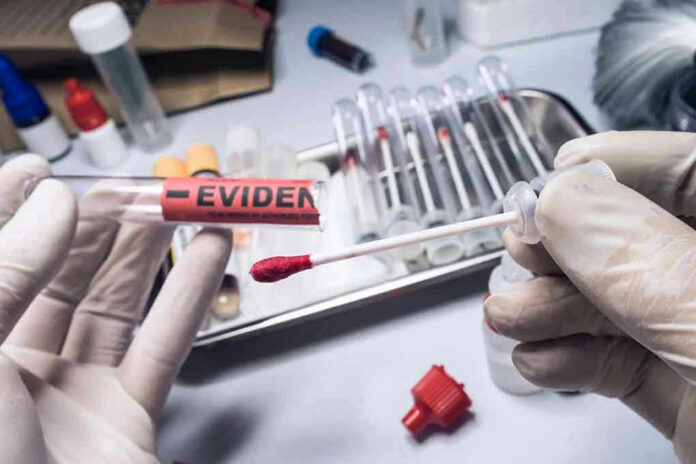
A long-dormant fingerprint tied to the Black Dahlia case is being re-examined for a link to Elizabeth Short’s ex-boyfriend—reviving a notorious mystery and raising hard questions about evidence integrity and transparency.
Story Highlights
- Los Angeles Police Department is examining a “new” fingerprint lead potentially linked to an ex-boyfriend of Elizabeth Short, known as the Black Dahlia [1].
- Investigators originally confirmed Short’s identity in 1947 by transmitting her fingerprints to the Federal Bureau of Investigation (FBI) via an early fax process [4].
- Historical chain-of-custody problems, including media handling of mailed evidence, may complicate any modern match [4].
- Cold cases often see periodic “breakthroughs” that rarely lead to convictions, underscoring the need for verifiable documentation [1].
LAPD Focuses on Re-Examined Fingerprint and Ex-Boyfriend Angle
Popular Mechanics reported that Los Angeles Police Department personnel are reviewing a fingerprint connected to the 1947 Black Dahlia murder to assess whether it matches one of Elizabeth Short’s former boyfriends, signaling a potential lead in the country’s most infamous cold case [1]. The report describes renewed interest amid broader archival re-examinations. The outlet did not publish a full forensic report or disclose method specifics, leaving key details—such as print source, chain-of-custody documentation, and comparison protocols—undisclosed to the public.
Los Angeles investigators successfully used fingerprints in 1947 to confirm Short’s identity, transmitting her prints via the Los Angeles Examiner’s “Soundphoto” to the Federal Bureau of Investigation, which matched prior records from a minor arrest later that same day [4]. That original fingerprint confirmation proves prints were central to the case from the outset. Today’s review seeks to leverage modern comparison tools, but any claimed match will hinge on rigorous documentation, given the case’s long history and prior evidence handling controversies.
Evidence Integrity Concerns Shadow Any Modern Match
Contemporary accounts show that soon after the killing, a package of Short’s personal effects was mailed to the Los Angeles Examiner and handled by newspaper staff before police analysis—a breach that reportedly included gasoline cleaning that could have damaged fingerprints and trace materials [4]. That contamination risk casts a long shadow. Any new fingerprint assessment must clearly establish where the print was found, how it was preserved since 1947, and whether it remained sealed from third-party handling to satisfy chain-of-custody standards expected in court.
The initial investigation explored more than 150 suspects and fielded numerous confessions without filing charges, illustrating how partial leads, including prints, never matured into prosecutable evidence at the time [4]. Given that backdrop, the present claim requires more than suggestive overlap. Documented provenance, examiner notes, and comparison metrics are essential. Without those, public announcements risk becoming another cold-case cycle of intrigue without accountability, a pattern common in older, high-profile homicides that see regular “breakthrough” headlines but few resolutions [1].
What a Credible Fingerprint Case Would Need to Show
Modern friction ridge analysis relies on documented features and comparison protocols that are transparent and replicable. A credible match in this case would specify the print’s surface type, the preservation environment since 1947, and the exact standards used for comparison, including examiner agreement thresholds and any algorithmic assistance. Practitioners emphasize that clear provenance and method disclosures are essential to guard against confirmation bias and ensure courtroom reliability in legacy evidence evaluations [3].
Black Dahlia breakthrough: LAPD examines new fingerprint tied to victim’s ex-boyfriend https://t.co/EfBNzCsJEG
— lucky (@A_zhang1) May 14, 2026
Conservative readers expect institutions to earn trust with facts, not hype. The responsible path here is straightforward: Los Angeles Police Department can release a redacted forensic summary confirming the print’s source location, storage history, and step-by-step comparison to the named ex-boyfriend, alongside exclusion comparisons to prominent alternative suspects. That sunlight would deter sensationalism, respect due process, and align with a law-and-order approach that prioritizes truth over headlines.
Historical Context: Why Verification Matters Now
Media fascination has periodically revived the Black Dahlia case with fresh theories, yet most lacked the documented rigor necessary for charges or convictions. Popular Mechanics frames the current development within that tradition of renewed leads, cautioning that results often depend on the quality of preserved materials and the clarity of the evidentiary trail [1]. By contrast, the 1947 identification via fingerprint transmission to the Federal Bureau of Investigation stands as a rare, well-documented success in a case otherwise marred by mishandled items and thwarted leads [4].
Bottom Line for Readers
If Los Angeles Police Department substantiates a legitimate, well-documented fingerprint match to an ex-boyfriend, the country could see movement in a case that has defied justice for nearly eight decades. If documentation remains thin, the public should treat the claim as provisional. Demand specificity: origin of the print, custody record since 1947, comparison methodology, and confirmable results. Justice requires discipline, not spectacle—especially when history shows how easily mishandled evidence can derail the truth [1][4].
Sources:
[1] Web – New Evidence May Revive the Unsolved Black Dahlia …
[3] Web – Fingerprint Evidence in Focus: Heidi Eldridge Clarifies …
[4] Web – Elizabeth Short’s fingerprints