

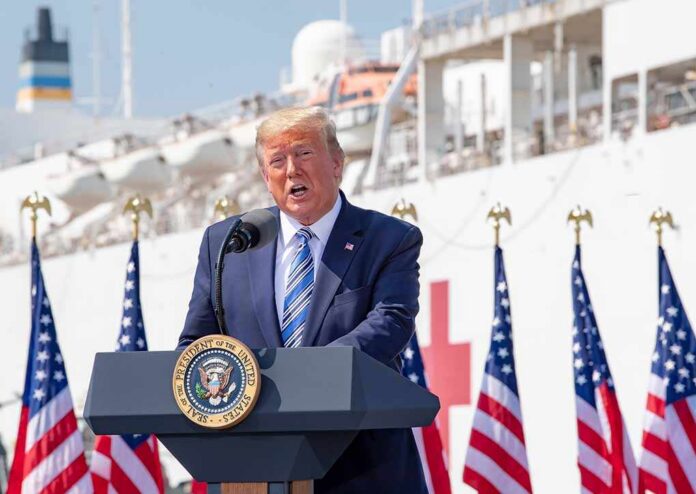
President Trump just told the country his own Vice President was wrong to skip the hardest question of all: would he do it again.
Quick Take
- Vice President JD Vance said on social media that the Iran war, not just the economy, cost Republicans the 2026 midterms.
- President Trump called Vance’s take “largely true” but said Vance dodged whether the war was worth it.
- Trump insists he would strike Iran again because the country can never be allowed a nuclear weapon.
- History from the 2006 Iraq midterms shows wars can hurt a party at the polls, but pinning one exact cause is rarely simple.
Vance Names The War As The Culprit
Vice President Vance posted on X on November 4, 2026, that “the reason we lost is the war,” adding that President Trump had said the same thing the night before. Vance went further, writing that many 2024 Trump voters had switched to Democrats in 2026, not just stayed home. That is a sharper claim than simple voter apathy. It says Republicans actively lost people who once stood with them.
Vance did not stop at blame. He laid out four fixes he said voters wanted: end the war, fix the cost of living, put America first, and rethink the relationship with Israel. Multiple outlets, including the Jerusalem Post, NBC News, Politico, and the Associated Press, reported the same post and timing within hours of each other on November 4.
Trump Agrees, Then Pushes Back Hard
President Trump did not deny the war hurt Republicans. He called Vance’s assessment “largely true” and said the conflict pushed gasoline prices up for a short stretch, right when voters were already feeling squeezed by inflation. That is a real concession from a sitting president about his own foreign policy decision. Few politicians admit a war cost their party seats, even briefly.
But Trump made clear he saw a gap in Vance’s story. He said Vance never answered whether he would still strike Iran, knowing what it cost at the ballot box. Trump answered that question for himself. He said his answer was “an emphatic yes,” because Iran can never be allowed to build a nuclear weapon. He framed the strike as a long-term security call, not a short-term political one, saying “you have no choice. You have to do it.”
A Lot Of People Didn’t Like His Comments
Trump’s public response zeroed in on how Vance’s words landed. He said plainly that a lot of people did not like Vance’s comments, treating them less as a policy disagreement and more as a public relations problem inside his own administration. That is a notable rebuke. A sitting president rarely corrects his own vice president this openly, especially just days after a brutal midterm defeat.
The timing matters too. Reports noted Vance has said he will decide after the election whether to run for president in 2028, and some coverage framed his comments as an attempt to put distance between himself and Trump’s war decision. That context does not prove Vance was wrong about the war’s effect. But it does give skeptics a reason to read his statement as partly political positioning rather than pure analysis.
What The Evidence Actually Shows
Here is the honest gap in this story. Vance referenced an unnamed pollster who found ending the war was a top answer from voters, but no outlet has published the poll’s sample size, questions, or methodology. Nobody has produced a district-by-district breakdown proving the war, rather than inflation or candidate quality, flipped specific races. Trump’s own comment tied the damage to gas prices, which blurs whether voters rejected the war itself or just its cost at the pump.
History offers a useful comparison, though not a perfect one. In 2006, Iraq became a referendum on President Bush, and Pew found 51 percent of voters citing national issues named Iraq as their top concern, well ahead of the economy. Among voters who disapproved of that war, 80 percent backed Democrats. Researchers later found Republican senators from states with heavy recent casualties took an extra hit at the polls. Wars can clearly move votes. But even in 2006, with a mountain of polling data, researchers never settled on one clean number for how much Iraq alone swung the outcome.
That is the real lesson for 2026. A war that raises prices and drags on without a clear end can absolutely sour voters on the party in power. Vance may be right that Iran was a major factor. Trump may also be right that the decision was still correct for national security. Both things can be true at once, and conservative voters weighing this fight deserve a straight accounting, not just dueling social media posts.
Sources:
nypost.com, people.com, nbcnews.com, politico.com, apnews.com
© conservativesense.com 2026. All rights reserved.