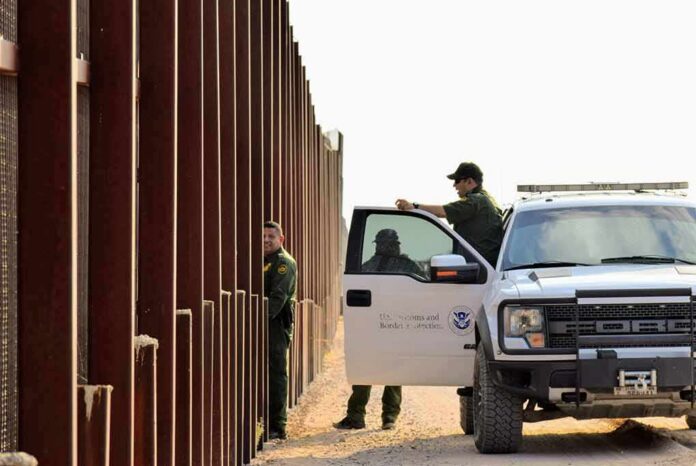
The Supreme Court just cleared the way for bulldozers to roll again across one of the most remote stretches of the Texas border.
Quick Take
- The Supreme Court voted 8-1 to let border wall construction resume in the Big Bend region.
- The ruling lifts a lower court injunction that had paused building since early October.
- The Department of Homeland Security (DHS) argued the pause harmed border security operations across a 517-mile sector.
- Ranchers, river guides, and environmental groups say the project will permanently scar a fragile desert landscape.
- The fight over wall construction continues in the lower courts even as building restarts.
What The Supreme Court Decided And Why
The Supreme Court’s emergency order grants the Trump administration’s request to pause a federal judge’s injunction. Judge Kathleen Cardone had blocked construction after finding the government likely overstepped its waiver authority. DHS asked the high court to summarily reverse that ruling, arguing border security needs outweighed concerns raised by local landowners and conservation groups. The justices agreed, with only one dissent.
Cardone’s original order did more than block wall panels. It froze all construction and ground-disturbing work tied to federal waivers covering roads, lighting, and related infrastructure across a huge sector of the border. That broad scope is why the ruling carried weight far beyond a few miles of fencing. It touched nearly every piece of the government’s Big Bend build-out plan at once.
The Government’s Case For Moving Fast
DHS leaned on a simple number to make its case. The agency pointed to more than 89,000 apprehensions across the sector between fiscal years 2021 and 2025 as proof the area needs stronger barriers. The government also argued that its operational and security interests clearly outweigh what it called “aesthetic, recreational, or cultural injuries” raised by the people challenging the project.
That framing matters. Border security is a constitutional duty, not a courtesy extended to environmental groups. Still, a skeptical reader should ask whether that apprehension figure actually maps onto the specific construction corridor in dispute, since the public record does not break the number down by location. Numbers persuade judges and the public alike, but only when they measure the right thing.
Why Local Residents Pushed Back So Hard
The opposition wasn’t abstract. River guide Danny William Miller testified that a wall across his property would cut off his access to the Rio Grande entirely. He compared it to “a bullet to the head” and said his business would turn into “a tour of the military industrial complex, rather than a tour of the wilderness”. Rancher Bill Guerra-Addington called a potential barrier “a death sentence” for his land along the river.
Environmental groups amplified those personal accounts with harder science. Earthjustice warned that clearing riverside vegetation for barriers would increase erosion and sediment, threatening aquatic life and drinking water for millions on both sides of the border. The Center for Biological Diversity said the waivers represented the first time the federal government set aside a full slate of park protections, including the Endangered Species Act, inside a national park.
A Procedural Win, Not A Final Verdict
Here’s the catch opponents keep pointing to: this was an emergency ruling, not a final decision on the merits. Cardone’s underlying lawsuit continues, and she had already found the challengers likely to succeed on their legal claims. Texas Civil Rights Project attorney Dustin Rynders noted that at the original hearing, the government called no witnesses and offered no direct evidence of high illegal crossings in Big Bend itself.
That gap in the record is a legitimate weak spot. If the administration wants public buy-in beyond a procedural win, releasing sector-specific crossing data and operational assessments would go a long way. A national security argument is only as strong as the evidence behind it, and right now much of that evidence sits in filings the public hasn’t fully seen.
The Bigger Debate Over Whether Walls Work
This case lands inside a much older argument. Some economists find fencing cuts migration meaningfully in certain corridors, while other researchers find barriers get circumvented or simply shift crossings elsewhere. Big Bend’s defenders note the terrain there is already brutal and remote, which they say makes it a natural deterrent without a wall at all. The honest answer is that effectiveness depends heavily on terrain, enforcement staffing, and local crossing patterns, not a one-size-fits-all formula.
🚨🇺🇸 MASSIVE WIN FOR PRESIDENT TRUMP AND BORDER SECURITY! 🇺🇸🚨
THE SUPREME COURT JUST RULED 8–1 IN FAVOR OF THE TRUMP ADMINISTRATION! ⚖️🔥
In a major victory for President Trump’s border security agenda, the U.S. Supreme Court has lifted a lower court’s injunction, allowing… pic.twitter.com/IytJ7G46EE
— NateBige (@natebige_) November 10, 2026
Construction can now move forward while the underlying lawsuit plays out in Cardone’s courtroom. Expect more testimony, more site visits, and likely another appeal no matter who wins the next round. For now, the administration has its green light, but the legal and environmental arguments against the project haven’t gone anywhere.
Sources:
cbsnews.com, yahoo.com, republic.land, aljazeera.com, houstonpublicmedia.org, pbs.org, azcentral.com, biologicaldiversity.org
© conservativesense.com 2026. All rights reserved.