
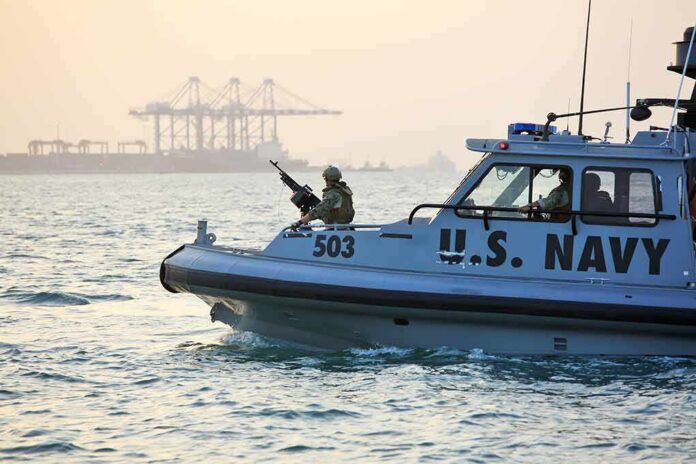
When navies operate in crowded chokepoints, intent can matter as much as capability; that is why the U.S. decision to destroy an Iran‑affiliated dhow in the Gulf of Oman—after first removing its crew—turns on a simple operational truth: persistent, targeting-quality surveillance against warships is treated as a threat, and commanders are obligated to neutralize it.
At a Glance
- U.S. Central Command says U.S. forces destroyed an Iran‑affiliated dhow in the Gulf of Oman on October 6 after it conducted surveillance and targeted U.S. Navy ships.
- CENTCOM reports the crew was evacuated before the vessel’s destruction; repatriation efforts were underway afterward.
- Multiple outlets echoed the core account: Iranian affiliation, surveillance role, alleged targeting, and crew evacuation.
- The episode fits a long-running pattern in the region where reconnaissance and coercive signaling blur into operational targeting, with real legal and tactical consequences.
What CENTCOM says happened and why it matters
According to U.S. Central Command, on October 6 U.S. forces destroyed an Iranian‑affiliated dhow in the Gulf of Oman that was “conducting surveillance and targeting U.S. Navy ships.” The statement, released publicly on October 14, specified that the dhow’s crew was removed safely before the platform was destroyed, and that repatriation was in progress. Regional and international outlets carried the same core account, citing CENTCOM’s attribution and rationale. The significance is not the tonnage of the vessel—it was a small traditional craft—but the function: in modern maritime contests, a modest hull with sensors, radios, and a practiced crew can deliver targeting-quality information to a striker. That’s enough to trigger defensive action.
Force protection in narrow seas relies on breaking the adversary’s “find-fix-finish” chain at the earliest feasible point. A dhow that persists in pattern-of-life collection around U.S. warships, uses optics or emitters aligned to fire-control-quality reporting, or shadows beyond innocent passage, will be read as the “find” and “fix” legs of that chain; commanders, under standing rules, are expected to disrupt it before it matures into “finish.” CENTCOM’s framing placed this event in the context of months of IRGC-linked pressure on both commercial and naval traffic, underscoring why U.S. forces treat apparently innocuous collectors as operational enablers rather than neutral bystanders.
Mechanism: how a small dhow can enable a lethal strike
Traditional wooden dhows remain ubiquitous across the Arabian Sea and Gulf of Oman. Their utility as intelligence collectors lies in plausible presence and low acoustic, radar, and visual signatures. With stabilized cameras, AIS receivers, cell or satellite uplinks, and trained spotters, such craft can mark bearings, speeds, bridge routines, and emissions of nearby ships; augmented with pre-shared target folders, that reporting becomes targeting data. In contested waters, the delta between “maritime awareness” and “targeting support” is behavioral: persistence inside a warship’s defensive bubble, communications bursts keyed to maneuvers, stationing that brackets fleet transits, and cueing alignment with known strike windows. When that pattern emerges against U.S. ships, the dhow ceases to be incidental traffic and becomes an operational node.
Naval countermeasures scale accordingly. The soft end includes hails, warnings, maneuvering, and non-kinetic suppression of sensors; the hard end ranges from disabling fire to complete destruction of the platform. Here, CENTCOM emphasizes casualty avoidance—crew evacuated first—followed by destruction of the hull, which removes both the sensor mast and any onboard equipment cache from immediate reuse. That sequencing is tactically coherent: preserve lives, deny capability, and close the reporting loop the adversary seeks to exploit.
Context: why this keeps happening in the Gulf
The Gulf of Oman and the adjacent Strait of Hormuz funnel one-fifth of the world’s traded oil and are among the most intensively surveilled waters on earth. Both Iran and the United States operate under constant pressure to detect, signal, and deter. The operational ambiguity is chronic: surveillance, coercive signaling, and attack preparation can look similar from the outside. This is not a new pathology. After the 2019 tanker incidents, the U.S. publicly attributed responsibility to Iran on the basis of intelligence and pattern analysis, while initial public releases shared only fragments of that case; attribution remained disputed even as technical evidence pointed to sophisticated limpet-mine use characteristic of a state actor. The throughline is clear: maritime crises in this theater are repeatedly adjudicated by military commanders on the water while the evidentiary debate unfolds more slowly on shore.
Legally, the touchstones are narrow but firm. Absent a Security Council mandate, force at sea rests on self-defense: an actual or imminent armed attack, necessity, and proportionality, interpreted in a naval environment where proximity, speed of engagement, and the vulnerability of shipping compress timelines. Scholarship and state practice converge on that frame even as they argue its edges, especially in straits and international waters adjacent to territorial seas. Commanders are trained to assess behavior and capability, not declared intent, because the latter tends to reveal itself only when it is too late to matter.
How this action fits broader U.S.–Iran naval friction
Since early 2026, reported IRGC actions against commercial and military shipping, projectile launches across the theater, and American interdictions and strikes have raised baseline risk across Hormuz-adjacent waters. Threat levels for commercial transit have periodically spiked to “severe,” a signal to shipowners that plotting, convoying, and insurance assumptions must adjust to state-on-state confrontation risks rather than piracy alone. Within that pattern, U.S. actions against mine layers, fast-attack craft, and intelligence collectors form part of a defense-in-depth aimed at keeping sea lanes open and deterring opportunistic attacks that exploit the clutter of civilian traffic. In that logic, removing a persistent surveillance node near U.S. warships is not a discrete episode but one move in a continuous counter-targeting campaign.
This is also why the manner of execution—crew evacuation followed by destruction—matters beyond the single hull. It communicates two messages simultaneously: the United States is willing to use force to deny enabling functions, and it will condition that force to minimize loss of life when tactically feasible. In an information contest where both sides court international shipping and regional partners, those paired signals are strategic assets as much as operational choices.
What to watch next: operational signals in plain sight
For outside observers, the most reliable leading indicators will not be press statements but observable maritime behavior. Expect to see U.S. and partner warships tighten exclusion practices in approach lanes, more assertive hailing and maneuver blocks against shadowing craft, and episodic kinetic actions against platforms that persist in surveillance roles close aboard. Commercial operators will adjust as well: higher guard conditions transiting Hormuz, route spacing to complicate targeting, and closer coordination with the Joint Maritime Information Center when risk levels elevate. None of this resolves the core ambiguity—reconnaissance and targeting still rhyme at sea—but it does shift the cost calculus for anyone trying to collect against U.S. hulls in narrow waters.
Sources:
article.wn.com, gulfnews.com, foxnews.com, gcaptain.com, store.jpost.com, asil.org
© conservativesense.com 2026. All rights reserved.