
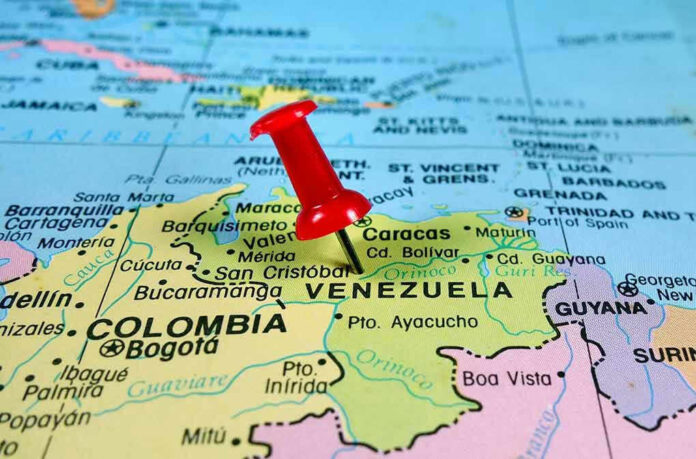
A potential collapse in Venezuela’s leadership could reshape the region’s political landscape, leaving conservatives questioning the future of democracy and sovereignty in Latin America.
Story Highlights
- Venezuela’s leadership crisis deepens with potential power shifts.
- Maduro’s regime faces allegations of narco-terrorism.
- U.S. policies aim to counter Venezuela’s authoritarian tendencies.
- Conservative values at risk amid regional instability.
Venezuela’s Political Turmoil
Venezuela remains in the grips of political instability as Nicolás Maduro’s regime faces mounting pressure both domestically and internationally. With allegations of narco-terrorism linking the regime to criminal activities, questions arise about the country’s direction post-Maduro. As the crisis unfolds, the potential for shifts in power dynamics looms large, raising concerns over the erosion of democracy and sovereignty in the region.
Amidst this turmoil, the influence of external actors like the U.S. becomes more pronounced. The U.S. has intensified efforts to counter the Maduro regime’s authoritarian grip through sanctions and military operations, such as Operation Southern Spear. This campaign highlights the ongoing geopolitical struggle to ensure stability and prevent the spread of narco-terrorism from Venezuela to the broader region.
Conservative Concerns in Latin America
The current Venezuelan crisis poses significant concerns for conservatives who prioritize the protection of democracy and national sovereignty. As Maduro’s government clings to power, the potential for a political vacuum raises fears of increased influence from left-leaning movements and external actors like Cuba. These developments threaten to undermine conservative values that emphasize limited government and individual liberties.
Moreover, the impact on Venezuela’s economy, heavily reliant on oil, exacerbates the situation. The lack of diversification and ongoing poverty could lead to further destabilization, affecting not only Venezuela but also its neighboring countries. This could prompt a reevaluation of economic policies in the region, seeking more sustainable solutions that align with conservative ideals of free market and minimal state intervention.
Prospects for Post-Maduro Venezuela
As Venezuela faces the possibility of a post-Maduro era, the outcomes are uncertain. Potential scenarios include a resurgence of Chavismo or a shift toward more democratic governance. However, the risk of a right-wing reversal of Bolivarian gains also looms, which could lead to privatization and cuts in social spending. This situation demands careful navigation to preserve the nation’s sovereignty and protect conservative interests.
Ultimately, the future of Venezuela remains a topic of intense debate. The potential for regional instability, coupled with the challenges of addressing corruption and fostering economic growth, underscores the complexity of the situation. Conservatives must remain vigilant to ensure that any transition respects individual freedoms and the principles of democratic governance.
Sources:
Maduro’s Narco-Terror Plot – Washington Examiner
Gonzalez on Venezuela – Marxists.org
US Reengages Venezuela – Truthout