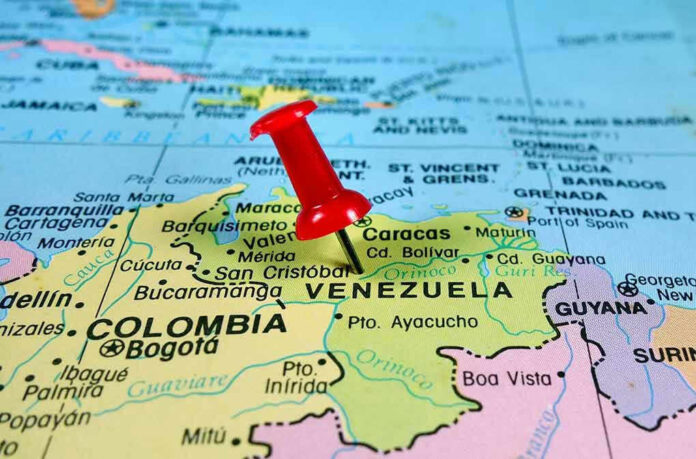
Venezuela’s Russian-supplied supersonic anti-ship missiles now pose a credible threat to U.S. Navy vessels in the Caribbean, fundamentally altering America’s naval dominance in our own hemisphere.
Story Highlights
- Venezuela publicly demonstrated Kh-31 supersonic missiles on Su-30MK2 jets during September 2025 military exercise
- These Mach 3.5 missiles can strike U.S. warships at ranges up to 110 kilometers with advanced guidance systems
- Russia’s military partnership with Venezuela directly challenges American naval supremacy in the Caribbean
- U.S. defense officials express concern over this escalation while reassessing regional naval strategy
Russian Missiles Target American Ships
Venezuela’s Defense Minister Vladimir Padrino confirmed operational deployment of Russian Kh-31 anti-ship missiles during the “Sovereign Caribbean 200” exercise on La Orchila island in September 2025. These supersonic weapons, fired from Su-30MK2 fighter jets, represent a dramatic escalation in Venezuela’s ability to threaten U.S. naval forces. The Maduro regime deliberately showcased this capability as a direct message to Washington, demonstrating how Russian military support undermines American security interests in our traditional sphere of influence.
The Kh-31 missile system includes both anti-ship variants capable of striking surface vessels and anti-radiation versions designed to suppress American radar networks. Defense analysts confirm Venezuela maintains at least 21 operational Su-30MK2 jets from an original purchase of 24 aircraft, providing multiple launch platforms for these advanced weapons. This represents a qualitative leap beyond Venezuela’s previous maritime strike capabilities and creates new tactical challenges for U.S. Navy operations in Caribbean waters.
Technical Capabilities Threaten Naval Operations
The Kh-31A anti-ship missile travels at Mach 3.5 speeds with a range of 70-110 kilometers, carrying a 94-100 kilogram high-explosive warhead guided by active radar seekers. Expert analysis from Army Recognition notes that while U.S. layered defenses including Aegis systems and electronic warfare capabilities complicate successful strikes, the supersonic speed and advanced guidance systems create genuine risks. Effective missile employment would require favorable tactical conditions such as surprise attacks or coordinated salvos to overwhelm American defensive systems.
Venezuela’s missile inventory also includes Kh-31P anti-radiation variants with extended 250-kilometer ranges specifically designed to target radar installations. These weapons provide dual capabilities for both direct naval strikes and suppression of American electronic surveillance networks. The combination of anti-ship and anti-radiation missiles gives Venezuela asymmetric warfare options that force U.S. naval commanders to account for credible threats when operating near Venezuelan territorial waters.
Strategic Implications for American Security
This development fundamentally alters the strategic balance in the Caribbean, traditionally considered an American lake where U.S. naval forces operated with impunity. Russia’s provision of advanced anti-ship missiles to Venezuela represents Moscow’s expanding influence in the Western Hemisphere and direct challenge to American maritime supremacy. The timing coincides with increased U.S. naval deployments to the Caribbean region, creating potential flashpoints where miscalculation could escalate into broader conflict between American and Russian-backed forces.
U.S. defense officials now face pressure to invest in enhanced countermeasures and adjust naval tactics to address this emerging threat. The presence of supersonic anti-ship missiles complicates freedom of navigation operations and power projection capabilities that America has long taken for granted in Caribbean waters. This represents exactly the type of strategic challenge that occurs when previous administrations fail to maintain decisive military superiority and allow adversaries like Russia to establish footholds in critical regions.
Sources:
Are Russian Kh-31 Anti-Ship Missiles in Venezuela Putting US Warships at Risk
Venezuela Threatens US Navy with Su-30MK2 Jets Armed with Kh-31 Ship Killer Missiles
Venezuela’s Supersonic Anti-Ship Missiles Are a Real Threat to American Warships
The United States Is Concerned About the Presence of Russian Kh-31 Anti-Ship Missiles in Venezuela