

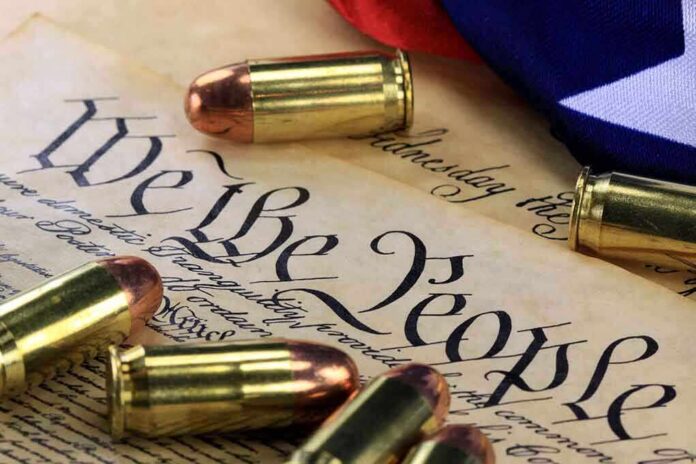
The live legal fight over AR-15 regulation is not really about cosmetics or culture; it is about where the Constitution draws a line between “arms” the people may keep and bear and weapons the state may treat as exceptional. That line, once abstract, is now being litigated with precision hardware in mind.
The Short Version
- Virginia’s attorney general has urged the Supreme Court to hold that AR-15–style rifles fall outside the Second Amendment’s protection as “arms,” advancing a categorical theory grounded in danger and machine-gun adjacency.
- Gun-rights briefs answer that semiautomatic AR-15s are widely owned for lawful purposes and therefore squarely within the Amendment’s scope under the Supreme Court’s “common use” framework.
- The crux is definition and doctrine: how “arms” maps onto modern semiautomatics, and whether common civilian adoption constrains bans even when a weapon has fearsome criminal misuse potential.
- Policy evidence on assault-weapon restrictions remains limited or inconclusive on core public-safety outcomes, which leaves constitutional text and history doing most of the work.
What Virginia asked the Court to decide, and why that framing matters
In a Supreme Court amicus brief, the Commonwealth of Virginia—through Attorney General Jay Jones—contends that AR-15–pattern rifles are not “arms” protected by the Second Amendment. The submission’s central move is categorical: it argues these rifles sit outside constitutional shelter because of their similarity to machine guns and their purported inaptitude for self-defense, situating them among unusually dangerous weapons the state may restrict. This is not just rhetoric. It is an attempt to persuade the Court to adopt a definitional rule that narrows “arms” at the threshold, rather than reaching questions of historical tradition only after assuming coverage.
The strategy aims to short-circuit the familiar analysis from District of Columbia v. Heller and New York State Rifle & Pistol Association v. Bruen, which first asks whether the conduct implicates the text—keeping and bearing “arms”—and then tests modern regulations against the nation’s historical tradition. If AR-15s are excluded at step one, outright prohibitions become doctrinally easier to defend.
The counter-case: semiautomatic, commonly owned, and constitutionally ordinary
Opponents answer with a cleaner syllogism: AR-15s are semiautomatic rifles—one round fired per trigger press, no more—and tens of millions are owned by law-abiding citizens for self-defense, hunting, and sport. Under Heller’s emphasis on arms “in common use” for lawful purposes, they argue, these rifles cannot be categorically banned. That position appears not only in advocacy filings but also in the U.S. Department of Justice’s amicus brief, which states that the overwhelming majority of AR-15 owners possess them for lawful ends and that semiautomatic rifles are commonly used by law-abiding citizens. Trade and civil-rights amici press the same point: AR-15s meet every definition of “arms” the Court has embraced, and widespread lawful possession forecloses prohibitions that function as flat bans.
This rejoinder also tackles the machine-gun analogy on the facts. A semiautomatic AR-15 does not fire more than one round per trigger actuation; fully automatic weapons—machine guns—do. Federal law has long drawn that line, regulating automatic fire and conversion parts under the National Firearms Act while leaving semiautomatics outside that category. The ATF’s technical materials explain the conversion mechanics and why specific components, like auto sears, move a firearm into “machinegun” status—underscoring the legal and functional distinction Virginia’s brief attempts to blur.
Mechanism and definitions: why semiautomatic operation is dispositive in this debate
The constitutional argument cannot be divorced from the hardware. “Semiautomatic” describes a firing cycle in which the firearm uses energy from the prior shot to chamber the next round, but requires a fresh trigger press to fire again. That mechanical fact is why Congress and the ATF treat semiautomatics differently from machine guns—defined as weapons that fire more than one shot per trigger function or can be readily converted to do so via specified parts. The AR platform’s modularity makes illicit conversion possible; that is precisely why auto sears and related components themselves are controlled as machine guns. But possibility of conversion is not equivalence. The law targets the conversion path, not the semiautomatic baseline.
In constitutional terms, that baseline matters because Heller’s “dangerous and unusual” carve-out has never been read to sweep in any arm with military lineage or high muzzle energy; the focus has been ordinary civilian possession and use. The counter-briefs leverage that structure: if semiautomatic rifles are widely owned and chosen for lawful purposes, they are not “unusual,” and danger alone does not strip them of the “arms” label.
History, tradition, and the “common use” constraint
Heller rooted its protection in arms “in common use” by law-abiding citizens for lawful purposes, treating historical tradition as the limiting principle against weapons “dangerous and unusual.” Modern litigation extends that inquiry: Are AR-15s analogous to arms historically kept by citizens and militia-age men, or are they more like the regulated outliers—bombs, fully automatic weapons—long singled out for special control? Gun-rights amici argue the former, noting the portability and manual of arms that track with historically suitable militia weapons, and stressing ordinary defensive uses. The DOJ’s description of owner intent and practice reinforces that the rifles’ civilian center of gravity is lawful.
That doctrinal frame explains the emphasis on adoption numbers and use-cases. If a court is persuaded that AR-15s are both common and commonly used for lawful ends, categorical bans are hard to sustain under Heller and Bruen’s methodology; restrictions must then be historically analogized and narrowly tailored to specific dangers, not premised on categorical exclusion from the Second Amendment’s text.
Policy evidence is not carrying the day—and that shapes the legal stakes
Even if the constitutional analysis leads, policymakers and courts have looked for empirical ballast. The difficulty is that the research record on “assault weapon” bans is thin where it most matters. RAND’s comprehensive reviews classify the evidence on such bans’ effects on violent crime and mass-shooting lethality as limited or inconclusive, and find little beyond short-term effects on prices or sales. That does not prove futility; it does mean that, in courtroom settings governed by text-and-history tests, policy claims rarely rescue broad prohibitions. The constitutional line, not demonstrated efficacy, remains the decisive constraint.
That asymmetry explains Virginia’s definitional gambit. If the state cannot convincingly show a tradition of comparable historical regulation, and if evidence on modern efficacy is equivocal, the most promising route is to argue AR-15s were never “arms” in the constitutional sense to begin with. The counter-position seeks to keep the inquiry anchored in current civilian practice—common ownership and lawful use—as the doctrinal backstop.
Where the genuine disagreement lies—and what to watch next
The real fault line is not about whether AR-15s are powerful or misused in notorious crimes; both are true. It is whether power and misuse justify classifying them with machine guns for constitutional purposes, or whether semiautomatic operation and widespread lawful civilian adoption place them on the protected side of the ledger. Virginia’s brief stakes out the first proposition and urges the Supreme Court to bless it categorically. The DOJ and a range of amici articulate the second, pressing Heller’s “common use” logic to its modern conclusion for semiautomatic rifles.
Two practical implications follow. First, if the Court accepts categorical exclusion, legislatures will have broad latitude to enact AR-15 prohibitions, and future litigation will revolve around administrable definitions and carve-outs rather than constitutional coverage. Second, if the Court affirms that AR-15s are protected “arms,” the center of gravity will shift to regulation short of bans—training requirements, sensitive-place rules, and targeted enhancements for conversion devices—tested against historical analogues rather than categorical prohibition.
Sources:
twitchy.com, jurist.org, supremecourt.gov, rand.org, atf.gov
© conservativesense.com 2026. All rights reserved.