
The jeers that interrupted Hakeem Jeffries in Denver were not simply theater for the cameras — they were the sound of a structural tension inside the Democratic Party finally breaking into the open: the gap between what an opposition minority can promise and what it can actually deliver on the House floor.
Key Points
- Progressive protesters confronted House Minority Leader Hakeem Jeffries at a Democratic conference in Denver, calling him a “liar,” “traitor,” and “oligarch lapdog” and demanding impeachment of Defense Secretary Pete Hegseth.
- The outburst traces directly to a 211-204 House vote that referred Rep. Thomas Massie’s Hegseth impeachment resolution to committee — effectively killing it — after 11 Democrats were absent.
- Jeffries had publicly backed impeaching Hegseth, creating a visible gap between his stated position and his caucus’s floor performance.
- Jeffries has defended his record by pointing to a broader accountability-and-affordability agenda and by vowing Democrats would ultimately “run Pete Hegseth out of town.”
- The episode fits a long historical pattern: impeachment efforts led by a chamber minority rarely succeed, and the decisive variable is almost always partisan math, not individual leadership will.
What Happened in Denver
At a Democratic Party conference in Denver on November 13, protesters repeatedly interrupted Jeffries mid-address, shouting that he was a “f***ing liar,” a “f***ing traitor,” and a “f***ing oligarch lapdog,” while demanding he move to impeach Hegseth and criticizing his financial ties to private equity. Jeffries responded with a joke rather than a direct rebuttal, a choice that itself became part of the story circulating afterward — read by critics as deflection and by allies as refusal to dignify the disruption. The confrontation was captured on video and spread rapidly across both progressive and conservative media channels, each framing it to fit a preexisting narrative about Democratic disunity.
What makes this more than a viral clip is the specificity of the grievance behind it. The protesters weren’t venting generalized frustration with Washington; they were pointing at a single, documented legislative outcome that had occurred days earlier and that Jeffries himself had publicly staked a position on.
The Vote That Triggered the Confrontation
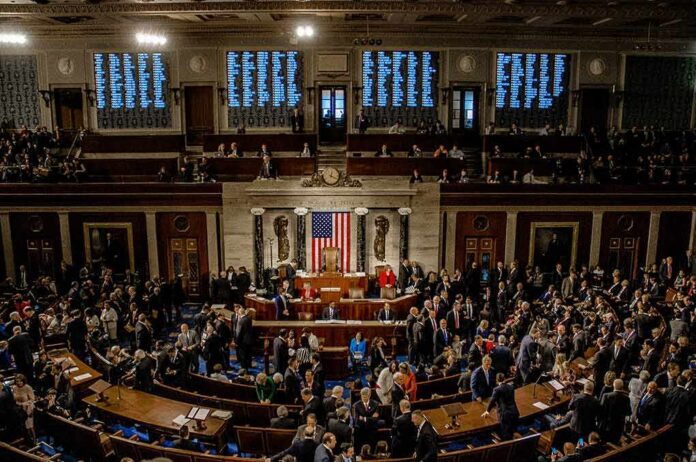
On November 10, the House voted 211-204 to refer Massie’s impeachment resolution against Hegseth to committee — a procedural maneuver that, in practice, shelved the effort rather than advancing it to a floor vote. Eleven Democrats were absent from that vote, a number large enough to have changed the outcome had they been present and unified. Reporting at the time described the result as a defeat for Jeffries specifically, not merely for the broader impeachment push, because Jeffries had already told reporters he was “a hard yes” on impeaching Hegseth. Some absent members later cited scheduling conflicts and travel delays, and Democratic leadership issued an apology over the missed vote — an unusual acknowledgment that the absences were avoidable rather than simply unfortunate.
Jeffries’s Defense and the Limits of the Evidence Against Him
Jeffries’s own public statements complicate the simplest version of the protesters’ charge. He has framed Democratic accountability efforts as governed by process rather than predetermined outcome, saying the caucus would “follow the facts, apply the law, be guided by the Constitution” rather than force a vote for its own sake. He has also paired accountability with an affordability agenda — lowering costs on housing, groceries, gas, and health care — arguing the two are complementary priorities rather than competing ones. Separately, Jeffries drew a hard line against a bipartisan Senate permitting bill, arguing it fell short on environmental review, tribal sovereignty, and House Democratic input — a dispute advocacy groups like the National Trust for Historic Preservation characterized as a call for a “more inclusive and constructive process,” not outright obstruction. None of this directly refutes the vote-count math from November 10. It does establish that Jeffries has a documented, consistent public rationale that goes beyond the single failed vote, and that intraparty disagreement — including from members like Rep. Sharice Davids, who argued permitting reform itself lowers costs — is not unique to the Hegseth episode.
Why Minority-Party Impeachment Efforts Usually Fail
The Hegseth vote did not fail in a vacuum. Academic research tracking 2,044 House members from 1973 to 2019 found that decisions to sponsor presidential-administration impeachment resolutions are driven heavily by ideology and party affiliation, with scandal severity as a secondary accelerant — not by the sincerity or intensity of any single lawmaker’s conviction. The Brennan Center has observed that impeachment as a check on the executive branch functions reliably only when the chamber majority is willing to exercise it; when the president’s party controls that chamber, institutional resistance collapses almost by default. Seen against that backdrop, the Hegseth referral looks less like a personal betrayal by Jeffries and more like the predictable output of a House where Republicans held the majority and where Massie was the lone GOP member to break ranks. That context doesn’t erase the 11 Democratic absences — it reframes them as a contributing failure within a structurally unfavorable vote, not the sole cause of Hegseth’s survival.
On November 13, 2026, House Minority Leader Hakeem Jeffries faced a public confrontation after progressive protesters interrupted his live discussion, accusing him of ignoring Democratic voters’ demands for impeachment, healthcare reform, and stronger action against the Trump… pic.twitter.com/Qkurvqmddt
— TMJ News Network (@tmjnewsnetwork) November 14, 2026
What the Episode Signals Going Forward
The Denver confrontation matters less as a moment of personal humiliation for one party leader than as a diagnostic event — it exposed, in public and unscripted form, the exact fault line that will keep recurring as long as Democrats hold House seats but not the House majority. Progressive activists will keep measuring leadership against maximalist accountability demands; leadership will keep answering in the language of procedure, coalition math, and sequencing. Both positions are internally coherent. The unresolved question — one no amount of shouting in a conference hall settles — is whether Democratic voters actually prioritize impeachment votes over affordability fights, a question the available reporting has not yet answered with anything resembling representative polling. Until that data exists, the argument between Jeffries and his critics will continue to be fought in viral clips rather than in verifiable numbers.
Sources:
theintercept.com, aljazeera.com, cbsnews.com, nwaonline.com, washingtonsun.com, huffpost.com, yahoo.com, thehill.com, wyomingnewsnow.tv, nationalreview.com, politico.com, abc7news.com, scholarlycommons.law.hofstra.edu, brennancenter.org
© conservativesense.com 2026. All rights reserved.