
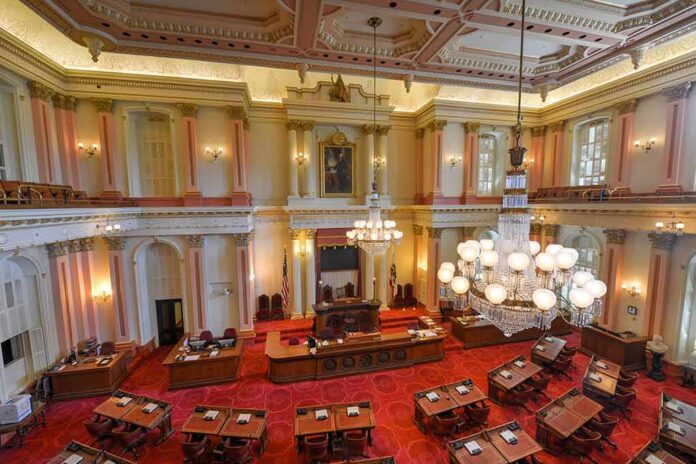
The Kosovo parliament episode is a study in how a procedural deadlock can harden into spectacle: when no bloc can govern alone, the fight over who gets to steer the transition becomes the fight itself.
Intro Header
- An opposition lawmaker threw eggs at Kosovo’s acting Prime Minister Albin Kurti during a parliamentary session in Pristina.
- The confrontation followed Kurti’s request for more time to negotiate a political agreement before naming parliamentary leadership.
- The dispute sits inside a broader stalemate over coalition arithmetic, the speakership, and the presidency.
- Kosovo has seen this kind of chamber disruption before; the symbolism is dramatic, but the underlying problem is structural.
What Happened in Parliament
An opposition lawmaker, Time Kadrijaj of the Alliance for the Future of Kosovo, hurled eggs at acting Prime Minister Albin Kurti during a plenary session that was meant to advance the formation of Kosovo’s parliament after the June snap election. Reporting from multiple outlets says Kadrijaj shouted “Shame on you!” or “Shame, shame” as she threw the eggs, while security officers and lawmakers moved in to intervene. The session was suspended after the confrontation.
The immediate trigger was Kurti’s appeal for additional time. He told lawmakers he did not yet have a political agreement and asked for more time to present the name of the speaker of parliament, saying that step was necessary to avoid fresh elections. That is the essential sequence: a stalled constitutive session, a request for breathing room, and a protest that turned the chamber into theater.
Why the Speaker’s Seat Matters So Much
In parliamentary systems, the speakership is not ceremonial furniture; it is part of the machinery that allows the legislature to exist as a functioning political body. In Kosovo’s case, the speaker has to be chosen before the process of government formation can move forward, so deadlock over that post blocks the path to a cabinet and keeps the country in limbo. That is why Kurti framed delay as a tactical necessity rather than a retreat: he wanted more time to assemble the broadest possible agreement and avoid another election.
The deeper issue is arithmetic. Kurti’s Vetëvendosje party won the largest bloc but not an outright governing majority, which forces him to seek backing from other parties. Several reports say negotiations with the Democratic League of Kosovo remained unresolved, with the presidency part of the bargain that rival parties wanted and Kurti unwilling to concede in the form they demanded. In other words, the egg-throwing was not a random outburst; it was an expression of a system where every institutional step has become hostage to coalition bargaining.
A Familiar Kosovo Pattern, Not an Isolated Outburst
The scene was startling, but not unprecedented. Kosovo’s politics has long featured confrontational parliamentary tactics when major disputes spill into the chamber. Reuters’ archive and later background reporting point to earlier episodes in which lawmakers pelted the prime minister with eggs over policy conflicts, and to the even more severe 2015–2016 period when opposition MPs used tear gas to block parliamentary business. That history matters because it shows the present incident belongs to a recognizable political repertoire, not a one-off breach of manners.
What changes from episode to episode is not the method of protest so much as the underlying grievance. In one era, the fight centered on a Serbia-related agreement and minority rights; in another, it centers on constitutional deadlines, coalition leverage, and the presidency. The medium is the same because the structure is the same: institutions that cannot absorb disagreement cleanly end up staging disagreement in public, under fluorescent lights, for the cameras.
What the Episode Reveals About Kosovo’s Political System
This is what post-election deadlock looks like when procedural rules meet polarized politics. The ballot box does not settle everything unless the election produces a governable majority, and Kosovo’s recent elections have left parties divided enough that institutional formation itself becomes the battleground. That produces a familiar sequence: a constitutional deadline approaches, negotiations intensify, accusations of bad faith multiply, and the chamber becomes a pressure valve.
Kurti’s own response captured the logic of the moment. According to reporting, he said he would be “happy to pay this price” if being hit by eggs was the cost of keeping political dialogue alive. Whether one reads that as restraint or performance, it reveals the governing premise behind his request: in a fragmented parliament, delay can be a lesser evil than forcing through a brittle arrangement that collapses immediately. The danger, of course, is that repeated delay corrodes trust and makes every compromise look like surrender.
Why This Matters Beyond the Chamber Floor
The practical stakes are larger than the optics. A country stuck in constitutive deadlock cannot move cleanly from election to government, and that uncertainty slows policymaking, weakens legitimacy, and invites more confrontation. Kosovo’s political class is therefore trapped in a self-reinforcing cycle: the inability to form institutions encourages dramatic protest, and dramatic protest makes institutional compromise even harder. That is why the egg attack resonated so widely. It was not only a gesture of anger; it was a compressed image of a political order that has not yet learned how to turn electoral competition into orderly rule.
Sources:
facebook.com, youtube.com, dw.com, indiatoday.in, tuko.co.ke, independent.co.uk, aljazeera.com, instagram.com
© conservativesense.com 2026. All rights reserved.