

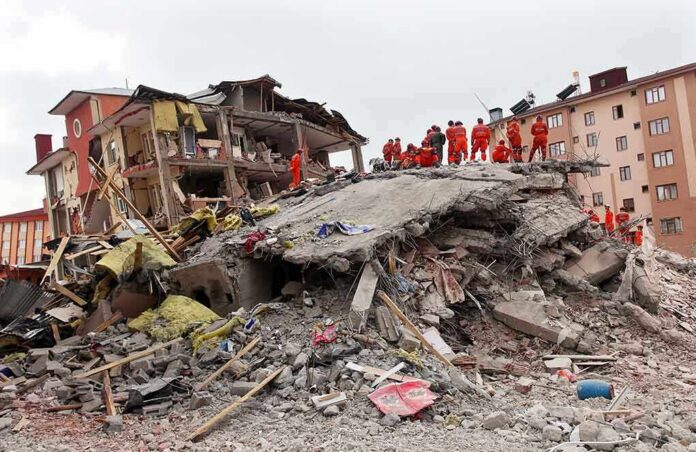
Two massive earthquakes struck Venezuela on June 24, 2026, killing nearly 3,000 people, collapsing hundreds of buildings, and leaving 50,000 unaccounted for — with U.S. scientists warning the final death toll could climb far higher.
Story Highlights
- A magnitude 7.2 foreshock and a magnitude 7.5 mainshock hit northern Venezuela within hours of each other, both earning the highest alert level from U.S. Geological Survey (USGS) scientists.
- The USGS Prompt Assessment of Global Earthquakes (PAGER) system put a 44% chance of between 10,000 and 100,000 deaths — a warning that drove urgent international rescue efforts.
- Nearly 800 buildings collapsed, 189 were completely leveled, and the confirmed death toll climbed past 1,700 within days, with the United Nations reporting at least 12,000 displaced.
- Venezuela’s socialist government drew sharp criticism for a slow, chaotic response — leaving citizens without supplies while rescue teams from more than 30 countries rushed in to help.
Back-to-Back Quakes Devastate Northern Venezuela
Two powerful earthquakes struck northern Venezuela on June 24, 2026, hitting near Yumare and sending shockwaves through the capital, Caracas. The first measured magnitude 7.2, followed hours later by a magnitude 7.5 mainshock. Both quakes earned a red alert from the USGS — its highest warning level — meaning scientists judged that widespread deaths and massive damage were highly likely. The back-to-back strikes overwhelmed emergency crews and knocked out communications across the region.
Nearly 800 buildings collapsed across the affected area, and 189 were completely leveled. Rescue teams dug through rubble for days. One survivor was pulled from the wreckage after eight days. With 50,000 people reported unaccounted for, officials warned that the final death count could be far higher than early numbers suggested. The United Nations confirmed at least 1,719 deaths and 5,000 injured as of Monday, with 12,000 people displaced from their homes.
USGS Warning System Flagged Catastrophic Risk
The USGS PAGER system — which rapidly estimates deaths and economic losses after major earthquakes — calculated a 44% chance that the magnitude 7.5 quake alone would kill between 10,000 and 100,000 people. The magnitude 7.2 foreshock carried a 41% chance of the same range. The Los Angeles Times reported the USGS computer models put a roughly 40% probability on fatalities in that range. These estimates are not confirmed counts — they are risk models based on population density, building quality, and shaking intensity.
PAGER builds its estimates using country-specific models that account for local construction practices and building weaknesses. Venezuela’s housing stock, much of it poorly built and aging, fit the profile for high casualties. The confirmed death toll of nearly 3,000 falls below PAGER’s high-probability range, but experts note that predictive models often run conservative in developing nations where data is limited and bodies take time to recover from rubble. The 50,000 still unaccounted for means the final number remains unknown.
Government Chaos and a Slow Response
Venezuela’s government struggled from the start. Early official death counts jumped rapidly — from 32, to 164, to 188, and then past 900 — without any clear explanation of how the numbers were being tracked. Health Minister Carlos Alvarado reported 235 dead and 4,300 injured on state television early on. Acting President Delcy Rodríguez later updated the count to 188 dead and 1,520 injured. The rapid shifts raised serious questions about how the government was counting victims and whether the real numbers were being reported accurately.
• Real disaster occurred: Twin earthquakes (magnitudes 7.2 and 7.5) struck northern Venezuela on June 24, 2026, near Yaracuy/Caracas, killing over 3,300 people, injuring ~16,000, and leaving thousands homeless, with heavy damage in La Guaira due to soft soils amplifying…
— B Burnworth (@bburnworth) July 6, 2026
Citizens vented frustration on social media over the lack of supplies and heavy equipment in the hardest-hit neighborhoods. Rescue teams from more than 30 countries arrived to help fill the gap left by a government that critics say has spent years running Venezuela into the ground through socialist mismanagement. The same failed policies that gutted the country’s economy and crumbled its infrastructure left ordinary Venezuelans far more exposed when the ground shook. U.S. Southern Command deployed 2,000 troops and a naval vessel to assist with relief operations. The disaster stands as a grim reminder of what happens when governments prioritize ideology over the basic needs of their people.
Sources:
townhall.com, instagram.com, earthquake.usgs.gov, miyamotointernational.com, usgs.gov, cnn.com, facebook.com
© conservativesense.com 2026. All rights reserved.