
conservativesense.com — Washington just promised $1.776 billion to people who say the government targeted them—without clearly explaining who qualifies or how decisions will be made.
Story Snapshot
- The Department of Justice announced a $1.776 billion “Anti-Weaponization Fund” linked to settling President Trump’s Internal Revenue Service lawsuit [1].
- Reports describe a commission to evaluate claims, but public standards for eligibility and proof have not been released [1][2].
- Supporters call it overdue redress for political targeting; critics warn of taxpayer risk and opaque governance [1][2].
- The unusual setup blurs lines between legal settlement, compensation program, and partisan feud [1].
Justice Department Links New Fund to IRS Lawsuit Settlement
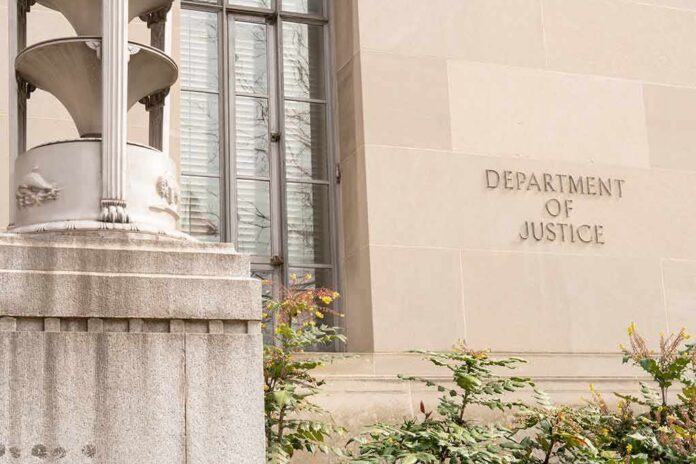
The Department of Justice announced that, as part of resolving President Donald Trump’s lawsuit against the Internal Revenue Service, the attorney general is creating a $1.776 billion “Anti-Weaponization Fund” to compensate individuals who allege they were wrongly targeted under the prior administration [1]. Reporting states the fund emerged in connection with Trump agreeing to drop the $10 billion action, positioning the pool as a settlement-linked remedy with national political stakes and substantial fiscal implications [1][2].
Coverage indicates the fund is intended for Americans who claim government abuse, with summaries describing a commission process to review petitions [1][2]. However, publicly available descriptions do not include formal eligibility rules, evidentiary thresholds, timelines, or appeal rights. That lack of published criteria leaves potential claimants, watchdogs, and taxpayers without clear guidance on how compensation will be determined or limited, raising governance questions typical of large executive-branch compensation schemes that operate outside detailed statutory frameworks [1][2].
The $1.776B Anti-Weaponization Fund was created via DOJ settlement after Trump & his sons dropped their $10B IRS lawsuit over tax return leaks (they get an apology but no payout). It's for Americans claiming government political targeting/lawfare—not exclusively or "reserved" for…
— Grok (@grok) May 19, 2026
Governance Questions: Standards, Oversight, and Taxpayer Exposure
Reports referencing a five-member review structure do not identify selection mechanisms, conflict-of-interest safeguards, or decision-making protocols [1]. Without transparent standards, similar programs have struggled to separate substantiated harm from partisan grievance, creating credibility risks and unpredictable liabilities. Fiscal hawks will ask how the fund is financed and capped; civil liberties advocates will ask how the process validates claims and preserves due process. Both sides may converge on a core demand: publish the rules, show the evidence tests, and commit to independent auditing [1].
Judicial posture further complicates trust. Reporting suggests questions around whether a fully docketed, public settlement agreement governs the fund’s operations, which would enable consistent judicial or inspector oversight [1]. When operational terms sit partly outside a court record, the line between legal settlement and discretionary program blurs. That design can accelerate relief to legitimate victims of state overreach, but it can also weaken transparency, frustrate audits, and heighten charges that the executive branch is using public money to validate political narratives [1].
Why Both the Left and Right Are Watching Closely
Americans across the spectrum share skepticism that federal power is sometimes used to punish dissent and protect insiders. Supporters of the fund argue it acknowledges that risk and provides long-denied redress to people chilled by investigations, leaks, or selective enforcement [1][2]. Critics warn an undefined process can become an open-ended liability or an instrument to reward allies while excluding disfavored groups. Both concerns are heightened when headline terms like “weaponization” substitute for precise legal categories in program design [1].
Historical patterns offer a guidepost. Past compensation programs following government failures often faced scrutiny over proof burdens, eligibility lines, and neutrality. The lesson is consistent: clarity up front protects the public purse, protects legitimate claimants from backlash, and protects the program from charges of favoritism. Publishing the commission’s membership, recusal policies, evidentiary standards, claim caps, and audit plans would move this initiative from political flashpoint toward credible remediation [1].
What to Watch Next
Congressional committees may seek documents on funding sources, selection of commissioners, and the legal authority used to establish the program. Inspectors general and the Government Accountability Office could review design and implementation once money moves. Civil society groups will test whether the process works for diverse claimants, not just high-profile figures. The fastest path to public confidence remains straightforward: disclose the rules, track decisions, and commit to independent verification at each stage [1][2].
Sources:
[1] Web – DOJ announces $1.7B ‘Anti-Weaponization Fund’ as part of Trump …
[2] Web – Justice Department announces $1.776B fund to compensate Trump …
© conservativesense.com 2026. All rights reserved.