
When a rider dies on a marquee roller coaster, the shock isn’t just emotional; it tests an industry that prides itself on engineering redundancy and vanishingly low risk, and it spotlights the disciplined, methodical investigations that follow when something goes terribly wrong.
The Short Version
- Police and park officials confirmed a guest died after an incident on the Goliath roller coaster at Six Flags Over Georgia; several others were reported injured.
- The park halted the ride, evacuated trains, and said it is cooperating with investigators while extending condolences to the victim’s family.
- Witnesses described a fall from the train and a chaotic aftermath, but the mechanism of the incident remains the subject of a formal inquiry.
- Fatal events on fixed-site amusement rides are rare relative to total ridership, though their consequences and public salience are immense.
What is known: a confirmed fatality, multiple injuries, and an active investigation
Cobb County authorities confirmed that one person died following an incident involving the Goliath roller coaster at Six Flags Over Georgia, and that other guests were injured. Police established a scene, initiated a major-crimes investigation consistent with any death in a public venue, and coordinated with park personnel as riders were evacuated from halted trains on the course. Six Flags publicly acknowledged the tragedy, expressed condolences, and stated it is working with law enforcement while supporting affected guests and employees. In the hours that followed, eyewitnesses described a fall from the train and the jarring evacuation process that left some riders stranded on an incline before being escorted down catwalks by staff and first responders.
Those are the settled facts. The specific chain of events that produced the ejection and subsequent injuries—component failure, operational lapse, rider posture or movement, or an unrelated medical event—will be resolved by the investigators with access to maintenance logs, restraint hardware, data systems, camera footage, and interviews. Until those findings are published, responsible analysis confines itself to the mechanics of how these systems are supposed to work and how inquiries are conducted.
How a hypercoaster like Goliath manages risk by design
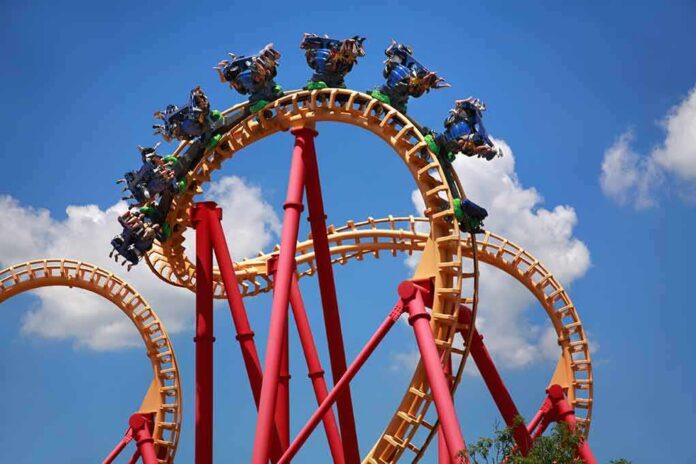
Goliath is a steel “hypercoaster,” a term of art for layouts featuring drops exceeding 200 feet and sustained high speeds. On such rides, forces are predictable but powerful: positive g-forces on valleys and transitions, and engineered “airtime” that produces partial weightlessness on crests. Modern hypercoasters use overbuilt structural steel, block-zone control systems that prevent train-to-train collisions by partitioning the course, and layered rider restraints. Trains typically rely on mechanically locking lap bars with multiple pawls or “dogs” engaging a toothed rack; many designs incorporate redundant engagement points so that a single-point failure does not defeat the lock. Operators perform pre-dispatch checks—visual confirmation, manual tug tests, sometimes sensor-verified lock confirmations—and dispatch only when every seat registers as secure. These are routine, almost ritualized steps intended to catch the rare out-of-tolerance condition before a train leaves the station.
When something abnormal occurs mid-course, multiple safeguards are still in play. Block sensors halt downstream advancement, trims can reduce speed, and operators can initiate an emergency stop that parks trains in the next safe zone. Evacuation then proceeds from fixed stairs and platforms designed into the structure, under a protocol that prioritizes medical attention for the most seriously affected guest while keeping others controlled and secured until they can be escorted off safely. The scenes that follow are unsettling even when procedures work as intended; they are designed first for safety, not comfort.
Why catastrophic ejections are so unusual—and so intensely investigated
Catastrophic ejections from modern, fixed-site roller coasters are exceedingly rare events. Historical federal analysis by the Consumer Product Safety Commission estimated 71 non-occupational fatalities on mobile and fixed-site rides over a 16-year period ending in 2002—roughly four to five per year across the entire U.S. market and ride universe studied. Industry-supported surveillance of fixed-site parks, conducted with the National Safety Council, has consistently characterized serious injuries as infrequent relative to rides taken—often summarized as odds in the tens of millions per ride—but any fatality triggers a top-to-bottom review by operators, regulators, and sometimes manufacturers to identify root cause and corrective actions.
The technical work begins with preservation of evidence: locking out the attraction, downloading programmable logic controller (PLC) logs, securing maintenance and operator records, and documenting every restraint, seat, and sensor state associated with the involved train. Investigators then triangulate: witness statements, physical trace evidence, the ride’s telemetry, and prior inspection and maintenance history. In the case of a potential restraint or train anomaly, the analysis extends to manufacturing QA records and, at times, component-level teardown. If the incident implicates procedures or human factors—load checks, guest positioning, or rider behavior—training records and station video become central to the reconstruction.
Competing hypotheses investigators test—and how they decide among them
Because the forces, paths, and timing of a roller coaster are deterministic, investigators can model whether a properly secured rider could be displaced at a given point on the course without a hardware fault; conversely, they can detect whether any mechanical condition existed that would allow unacceptable restraint travel under load. They test for seat-specific anomalies (mis-latched pawls, obstructions in the rack), ride control faults (sensor bypasses, error states), and dispatch protocol deviations. They also examine anthropometrics and posture: lap-bar systems are designed to secure across thighs and pelvis; seating position, clothing bulk, or intentional spacing can all affect fit. Eyewitness reports can be vivid but imprecise under stress; the physical record, corroborated by data and video, is what ultimately resolves cause.
If a defect is found or reasonably suspected, operators often suspend operation of the same model of ride elsewhere pending inspection—sometimes voluntarily, sometimes at a regulator’s direction. That precaution is not proof of shared risk; it is how a risk-managed industry treats uncertainty across a fleet until checks confirm conformity. If the cause lies in operations, parks revise procedures and training. If rider conduct or a medical event precipitated the outcome, findings may recommend guest-facing guidance or screening, even when the hardware and process met specification.
How to think about risk, responsibility, and the path forward
Fixed-site amusement rides remain a low-frequency, high-consequence risk category: the probability of serious harm is small on a per-ride basis, but the stakes are absolute for those involved. That’s why the duty of care borne by operators is stringent in many jurisdictions, shaped over decades of case law and evolving standards, and why modern parks invest in layered engineering controls, procedural redundancy, and continuous surveillance of incident data to spot weak signals before they become failures. When a fatality occurs, the industry’s credibility depends on a transparent, technically competent investigation and—crucially—on implementing whatever changes the facts demand.
For guests, the practical counsel is simple and unglamorous. Follow posted restrictions, including height and physical criteria designed around restraint geometry; allow operators to secure and, if necessary, adjust the restraint to full engagement; and if anything feels out of tolerance—excess play in a lap bar, a restraint that sits unusually high relative to the thighs—speak up and step out. These are not fail-safes against every scenario, but they align with how the systems are engineered to work.
BREAKING NEWS: A tragic safety incident occurred today on the Goliath roller coaster at Six Flags Over Georgia, resulting in one fatality and four injuries. In this video, we break down exactly what happened! https://t.co/gqUbfH39L4 pic.twitter.com/BnicN9G7Xv
— Shannel TV (@ShannelTV) October 13, 2026
What resolution looks like
Resolution in cases like the Goliath incident is not rhetorical. It is a dated report with root cause, corrective actions, and, if warranted, changes to hardware, maintenance schedules, operating procedures, or rider guidance. It is also measured in whether similar attractions return to service with documented inspections or modifications complete. That paper trail—paired with the statistical record—tells guests and communities whether the systems intended to keep extraordinary thrills inside the bounds of ordinary safety are functioning as they must. The family who lost someone doesn’t get a second chance. The rest of the system owes them, and the public, specificity, not platitudes.
Sources:
foxnews.com, 41nbc.com, 11alive.com, mdjonline.com, nbcnewyork.com, wtae.com, laughingplace.com, fox5atlanta.com
© conservativesense.com 2026. All rights reserved.