
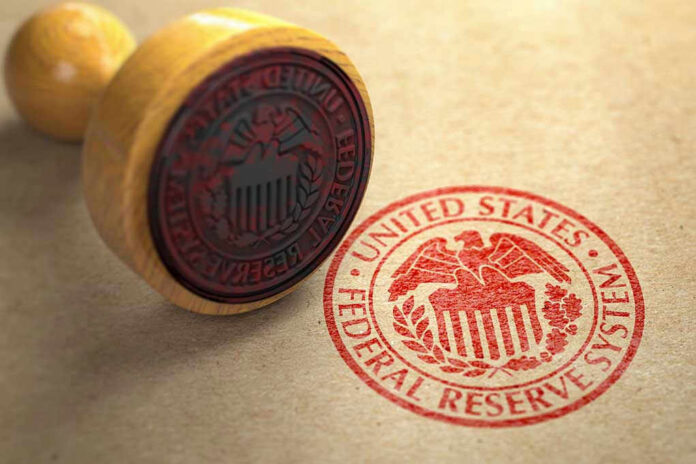
Federal Reserve Chair Jerome Powell’s recent press conference sparked sensational headlines claiming “major threats,” yet a careful examination reveals the Fed simply held interest rates steady while navigating oil price shocks and persistent inflation—a far cry from the alarming narrative pushed by clickbait media.
Story Highlights
- Fed maintains federal funds rate at 3.50%-3.75%, pausing after three rate cuts in late 2025
- Powell addresses oil price surge exceeding 50% since January due to Iran conflict, complicating inflation targets
- No evidence of “major threat” in official statements; sensationalized headlines misrepresent routine Fed caution
- Long-run rate projection rises to 3.1%, signaling sustained tighter monetary policy ahead
Fed Holds Steady Amid Oil Price Volatility
The Federal Reserve concluded its March 17-18, 2026 meeting by maintaining the federal funds rate at 3.50%-3.75%, marking the second consecutive pause after three quarter-point cuts ended 2025. Chair Jerome Powell’s press conference at 2:30 p.m. EST on March 18 addressed escalating oil prices driven by Iran conflict, which surged over 50% since January. The FOMC statement acknowledged economic expansion continues solidly while unemployment stabilizes, yet inflation remains elevated above the 2% target—a persistent challenge now entering its fifth year. This decision reflects the Fed’s cautious approach to balancing price stability against employment concerns amid geopolitical uncertainty.
Debunking the “Threat” Narrative
Despite alarmist headlines suggesting Powell issued a “major threat,” no such language appears in official Federal Reserve communications. Powell’s remarks focused on monitoring inflation pressures from oil prices and tariffs, noting the difficulty in discounting temporary energy spikes given inflation’s prolonged elevation. The Summary of Economic Projections showed minimal changes, with forecasters maintaining expectations for one rate cut in 2026 and one in 2027. Economist Lon Erickson from Thornburg Investment Management confirmed the Fed remains “comfortable” with current conditions, while Brandon Zureick of Johnson Investment Counsel anticipated only minor inflation adjustments in projections. This measured stance hardly constitutes a threat—rather, it represents responsible central banking amid complex economic crosscurrents.
Economic Implications for Americans
The Fed’s decision to hold rates carries real consequences for hardworking Americans already burdened by years of elevated prices. Borrowing costs remain elevated for mortgages, auto loans, and business financing, constraining economic activity while consumers face soaring fuel expenses from oil market disruptions. The FOMC’s updated long-run rate forecast of 3.1%, up from 3.0%, signals expectations for sustained tighter monetary policy—meaning relief for savers through higher interest returns but continued pressure on borrowers. Markets reacted with volatility, as investors had hoped for signals of imminent rate cuts. The Fed’s acknowledgment that inflation has exceeded targets for five consecutive years underscores the lingering damage from previous fiscal mismanagement and pandemic-era money printing.
Political Context and Powell’s Uncertain Future
Jerome Powell’s term as Fed Chair nears conclusion in 2026, adding political dimension to monetary policy deliberations. Powell has navigated extreme challenges since his 2018 appointment, including pandemic response, historic inflation spikes prompting aggressive 2022-2023 rate hikes, and subsequent 2025 cuts. The current Iran conflict complicates his final months, echoing 2022’s Ukraine crisis when energy shocks threatened to embed inflation expectations. Wells Fargo economists predicted the March statement would explicitly reference Iran-related uncertainty, which materialized as acknowledgment of assessment challenges. With solid GDP growth continuing despite softer February job reports, the Fed walks a tightrope between preventing recession and allowing inflation to resettle—a task complicated by geopolitical factors beyond monetary policy control.
Sources:
March Fed Meeting 2026: Live Updates and Commentary – Kiplinger
Federal Reserve – March 2026 News Events
Federal Reserve – FOMC Meeting Calendars
Federal Reserve – News & Events Calendar