

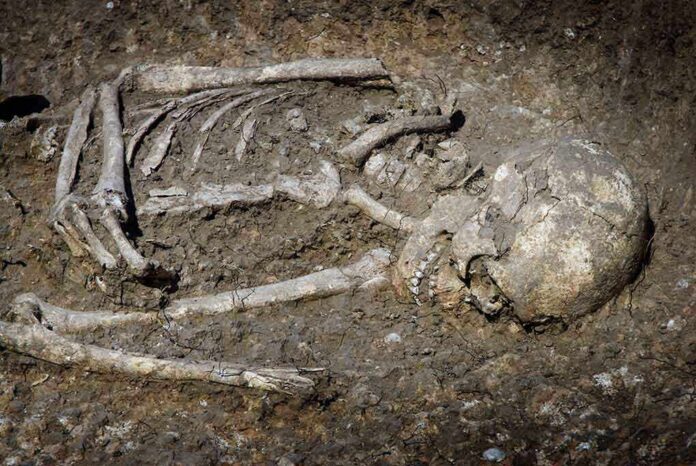
The real question in the Rising Star caves is not whether Homo naledi felt grief but whether the sediments, skeletal articulation, and cave physics meet the evidentiary threshold for deliberate burial; right now, the strongest data cut both ways, and the decisive test is reproducibility.
The Short Version
- Proponents argue multiple deep-cave features show intentionally dug, refilled pits containing articulated Homo naledi remains.
- Skeptics counter that natural processes—death traps, water transport, slumping—have not been excluded and that key sediment chemistry did not replicate.
- The current best case for burial is a minimal claim: repeated cultural interment without asserting rich symbolism.
- Resolution hinges on independent micromorphology, transparent geochemistry, and rigorous process modeling—work that is feasible but unfinished.
How the burial hypothesis is framed: a minimal cultural claim
The strongest version of the burial proposal is not a sweeping story about ritual; it is a constrained archaeological claim that some Homo naledi bodies were intentionally placed in shallow excavations, then rapidly covered. The excavators report discrete, subsurface disturbances in the Dinaledi Chamber and Hill Antechamber—contexts they interpret as grave-like features, with articulated body regions preserved in “matrix-supported” encasement consistent with quick burial before soft tissues decomposed. The team explicitly stakes a “minimal hypothesis of hominin cultural burial” as most compatible with the total pattern—repeated features in multiple cave locales, skeletal articulation suggestive of intact-body placement, and positions that, they argue, are not reproduced by gravity, downslope talus creep, or slow sedimentation.
This framing matters. It sets the bar as demonstration of purposeful placement and covering, not proof of symbolism. In paleoarchaeology, that distinction is crucial; it aligns the claim with core diagnostics—cut-and-fill structures, articulation, stratigraphic discontinuities—rather than with more speculative markers of meaning.
Where the counter-case bites: sedimentology and alternative processes
Two named critiques put real pressure on that minimal claim. First, a consortium led by María Martinón-Torres argues that the published record does not yet exclude natural formation scenarios—death traps, water transport of bodies or body parts, and carnivore activity—and therefore does not cross the evidentiary threshold for deliberate burial by Homo naledi. Second, a technical reanalysis by Kimberly Foecke, Alain Queffelec, and Robyn Pickering—the most pointed challenge—reports that sediment samples from the proposed features and surrounding cave deposits overlap in composition and that the original description of X-ray–based methods left out critical acquisition parameters, blocking independent reproduction. Their conclusion is stark: from a sedimentological standpoint, the current datasets do not substantiate deliberate burial.
These objections carry force for a simple reason: if a grave cut and refilled pit exist, they should be discoverable as a cut-and-fill structure with distinct microstratigraphy or geochemical signature. Absent those, the argument must rest on negative taphonomy—what natural processes did not do—which is weaker evidence. The Foecke team’s failure to replicate chemical contrasts and its report of no diagnostic jumbled-versus-ordered sediment pattern in standard protocols sharpen that point.
What counts as evidence for burial in deep caves
Archaeologists rarely witness intentional burial directly; they infer it from converging indicators: (1) unambiguous stratigraphic cuts and fills, (2) anatomical articulation consistent with intact-body placement, (3) rapid covering discernible in microfacies, (4) discrete feature boundaries differing from surrounding matrix, (5) chronological coherence, and (6) robust exclusion of plausible natural mechanisms. The Homo naledi case lands squarely in this inferential zone. The proponents emphasize articulation and repeated features across chambers and contend that gravity, talus creep, and slow deposition cannot reproduce the observed contexts. Critics reply that the published micromorphology and sediment chemistry have yet to demonstrate cut-and-fill or compositionally distinct fills, and that alternative transport and accumulation processes remain live options.
Independent editorial assessment has also urged caution: an eLife review team described the archaeological and taphonomic analyses supporting broader complex-behavior claims (burial, engravings, fire) as incomplete, a judgment that—fairly or not—spills over onto the burial claim itself.
Mechanism and feasibility: could small-brained hominins do it?
One subtext animating public debate is cognitive capacity. Homo naledi’s brains are small by Homo standards, but motor planning, social coordination, and controlled use of light in caves are not synonymous with symbolism. If the physical evidence clears the bar—repeatable features, intact placements, rapid coverings—then small brain size is not a decisive counterargument; the behavioral repertoire required for body placement and covering is well within plausible hominin range. The scientific issue is empirical, not neurological: do the sediments and bones record intentional excavation and covering, or the palimpsest of natural cave processes?
Why the case remains unresolved
On present evidence, the proponents have articulated a coherent, testable model across multiple loci and emphasized anatomical articulation and rapid covering; that keeps the burial hypothesis in serious contention. Yet the counter-evidence targets the single most diagnostic proxy for digging—sediment distinction—and reports both methodological opacity and negative replication results. That directly weakens the core of the burial argument as presently documented. When your strongest claimed diagnostic does not reproduce, the burden shifts back to generating decisive, transparent, and independently auditable datasets.
What would settle it: a roadmap for decisive tests
The path to resolution is not mysterious; it is procedural rigor. First, re-excavate feature margins that remain intact under independent permits, with preregistered protocols, to hunt for unequivocal cut boundaries and fill microstratigraphy. Publish complete thin-section micromorphology, particle-size spectra, and mineral geochemistry with full metadata. Second, release the original sampling coordinates, laboratory settings (including X-ray acquisition parameters), raw spectra, calibration files, and analysis code; invite blind reanalysis by external geoarchaeologists. Third, build high-resolution 3D models of skeletal articulation and sediment encasement, paired with taphonomic scoring, and benchmark them against experimental analogs of gravitational deposition, slumping, and low-energy water movement in geometrically constrained cave models. Finally, pin the timing with bracketing dates—optically stimulated luminescence on sediments above and below candidate features, and cross-checks via U-series where appropriate.
Judgment: a live hypothesis, not yet demonstrated
Weighing the specific evidence, the burial hypothesis is neither debunked nor demonstrated. The anatomical and spatial arguments keep it viable; the sedimentological non-replication keeps it unproven. The right standard here is not credulity or incredulity but adjudication by data that any qualified team can reproduce. Until cut-and-fill structures or equivalent diagnostics are documented in a way that survives independent scrutiny, the most responsible stance is conditional support for a serious hypothesis under active test—not acceptance, not dismissal.
Sources:
deephistory.substack.com, elifesciences.org, biorxiv.org, gmu.edu, sciencealert.com, wisconsin.edu
© conservativesense.com 2026. All rights reserved.