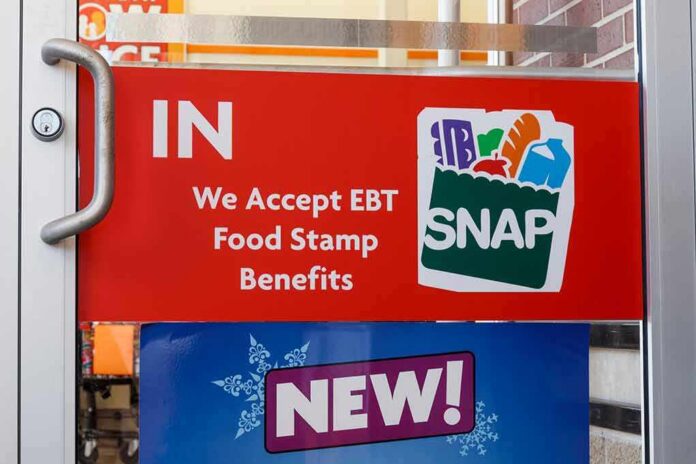
SNAP trafficking prosecutions are built on a simple economic distortion—trading federally funded food benefits for cash at a steep discount—and the Hollywood, Florida case against convenience store owner Al Amin shows, in concrete detail, how investigators say that distortion becomes a criminal enterprise measured in hundreds of thousands of dollars.
The Short Version
- Federal prosecutors charged Al Amin with two conspiracies—unauthorized acquisition/use of SNAP benefits and wire fraud—tied to an alleged $500,000 trafficking scheme.
- Investigators allege a cash-for-benefits model: buying EBT cards from recipients for roughly half their value, then using the cards to buy bulk goods for resale and store inventory.
- The complaint places the conduct from October 2023 through March 2026, centered on Kwik Stop 72 in Hollywood, Florida.
- An undercover operation reportedly involved about $64,388 in benefits exchanged for $29,474 in cash, illustrating the alleged discount-rate mechanism.
What prosecutors say happened—and the statutes they’re using
According to the U.S. Attorney’s Office for the Southern District of Florida, Al Amin faces two federal conspiracy counts: one tied to unauthorized acquisition or use of Supplemental Nutrition Assistance Program (SNAP) benefits under 18 U.S.C. § 371, and one for conspiracy to commit wire fraud under 18 U.S.C. § 1349. Conspiracy charges allow prosecutors to target coordinated conduct—planning, agreement, and overt acts—rather than isolated violations, which is why these counts are common in trafficking cases that involve multiple actors, repeated transactions, and digital benefit transfers that cross state or retailer systems.
The government’s theory is specific. Prosecutors allege that Amin and others purchased electronic benefits transfer (EBT) cards from SNAP recipients for approximately half of the cards’ available balances, paying cash on the spot. They then allegedly used the cards to buy bulk merchandise from retailers. Some goods, the complaint says, stocked Amin’s own convenience store; other goods were resold to additional store owners—turning discounted benefits into revenue streams through retail markup or wholesale flipping.
Timeframe, location, and the undercover example that shows the mechanism
The charging documents and court-based reporting place the scheme from October 2023 through March 2026, anchored at Kwik Stop 72 in Hollywood, Florida. That timeframe—nearly three years—matters for how losses are calculated and for the sentencing guidelines if there is a conviction; longer periods typically produce larger aggregate benefit totals and support the conspiracy narrative over a one-off lapse.
Investigators did not rely on inference alone. Reporting on the complaint describes an undercover operation in which an investigator provided EBT cards holding approximately $64,388 in SNAP benefits and received $29,474 in cash—almost exactly the half-off exchange rate prosecutors say characterized the trafficking. Undercover buys are staples in SNAP enforcement because they transform an abstract allegation into a discrete, documentable transaction with known card balances, timestamps, and, often, surveillance corroboration.
How this alleged scheme maps to the known playbook of SNAP trafficking
At the retailer level, SNAP trafficking typically follows a predictable loop: a beneficiary under financial strain sells benefits for cash; a complicit merchant captures the margin by redeeming those benefits at face value for food or by converting them to resale inventory; the U.S. government reimburses redemptions drawn from taxpayer funds. The Amin complaint, as described by prosecutors, fits that loop: cash-for-benefits at roughly 50 cents on the dollar, followed by bulk purchasing to monetize the full face value via stock or resale channels.
National program-integrity data put this in context. USDA’s most recent national studies estimate that about 1.6% of SNAP benefits are trafficked—roughly $1.27 billion annually in the 2015–2017 period—with an estimated 12.7% of authorized stores committing at least one trafficking violation over the study window. Those figures capture the problem’s persistence while underscoring that the vast majority of benefits and retailers operate legitimately. They also explain why enforcement zeroes in on patterns that match known trafficking signatures—high-value redemptions inconsistent with store size, repeated off-hour transactions, and unusually concentrated card use—before deploying undercover operations to confirm misconduct.
Hollywood Convenience Store Owner Charged in Alleged $500,000 SNAP Fraud Scheme https://t.co/HS0k7gun16
— Marlow62 (@Marlow3456) November 2, 2026
Why the charges, if proven, carry real penalties
Trafficking undermines SNAP’s core design: direct, restricted purchasing power meant to reduce food insecurity. When benefits are converted to cash at a discount, neither the government nor eligible households receive what the statute intends. That’s why prosecutors often pair the general conspiracy statute with wire fraud conspiracy in EBT cases: modern SNAP is digital, so fraudulent procurement, redemption, or resale that rides electronic systems naturally implicates wire transmissions—card authorizations, settlement messages, processor logs—that tie local conduct to federal jurisdiction and penalties.
Maximum statutory penalties can be severe—wire fraud conspiracy alone carries up to 20 years—but in practice sentencing rests on the U.S. Sentencing Guidelines, which revolve around provable loss amounts, role in the offense, obstruction, and acceptance of responsibility. The government’s reference to more than $500,000 signals why this case sits in felony territory and why the investigative team emphasized an undercover deal with precise, auditable figures.
How enforcement has evolved—and where this case sits within it
SNAP enforcement has matured alongside the program’s shift from paper coupons to EBT. Today’s investigations blend data analytics—flagging outlier redemption patterns, merchant risk profiles, and cardholder clustering—with traditional tools like store observations, subpoenas for invoices and inventory, and controlled buys. South Florida’s recent designation as a pilot focus area for SNAP-fraud enforcement reflects that evolution: regional tasking allows prosecutors and agents to coordinate faster, compare anomalies across retailers, and push cases with strong digital trails and corroboration. The Hollywood case emerged amid that emphasis, illustrating how a regional initiative channels resources toward retailer-level schemes with outsized dollar impacts.
None of this collapses the legal presumption of innocence—Amin has been charged, not convicted—but it does explain the government’s posture: specific statutes, a detailed modus operandi, a defined period and location, and a test transaction built to withstand evidentiary scrutiny. Those are the ingredients prosecutors lean on when moving from administrative sanctions to criminal court.
What to watch as the case proceeds
Several factual hinge points typically decide outcomes in cases like this. First, transaction proof: EBT processor data linked to specific purchases, time-stamped and reconciled to undercover card balances, tends to be decisive. Second, inventory and resale chains: invoices, delivery records, and communications that tie bulk goods to a store owner personally—rather than generic stocking—often separate administrative violations from criminal culpability. Third, cooperator testimony: if alleged co-conspirators or beneficiaries testify with corroboration from records, juries usually have a clear narrative line from purchase to profit.
On the policy side, expect enforcement to continue targeting retailer-level schemes even as national trafficking rates remain in the low single digits. The lesson from a decade of studies is consistent: most stores and beneficiaries follow the rules; a minority of bad actors account for a disproportionate share of the losses. Cases that allege half-price cash exchanges and six-figure totals are precisely the ones designed to deter would-be copycats and to signal that digital breadcrumbs make EBT-era fraud prosecutable at scale.
Sources:
townhall.com, justice.gov, cbsnews.com, sun-sentinel.com, storage.courtlistener.com, cubitanow.com
© conservativesense.com 2026. All rights reserved.