

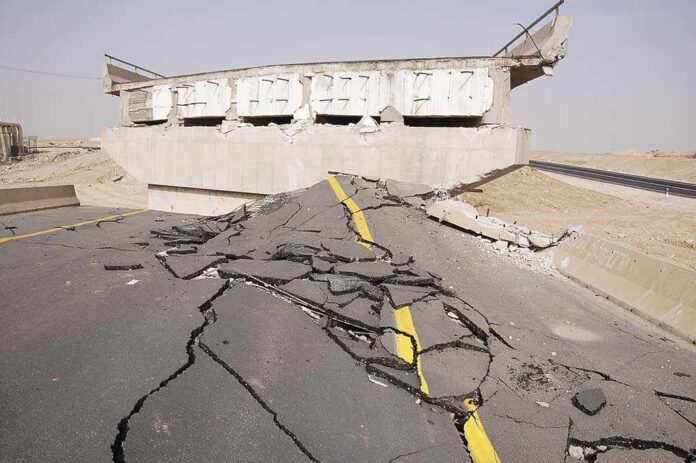
Israel’s destruction of southern Lebanon’s last usable crossing over the Litani River has turned a military tactic into an immediate civilian choke point for roughly 100,000 people.
Quick Take
- The Lebanese army says the Qasmiyeh (Kasmiyeh) Bridge near Tyre was hit and left unusable, cutting the last practical route across the Litani River.
- Israeli officials frame the bridge campaign as a way to block Hezbollah movement and resupply in a long-running border war.
- Lebanese authorities and local reporting warn the strikes are worsening an already severe displacement and aid-access crisis.
- By March 23, multiple bridges—including Al-Dalafa and another link near Nabatieh—were also reported destroyed, leaving no working Litani crossings.
What happened at the Litani River—and why it matters
Lebanon’s army reported that Israeli strikes destroyed the Qasmiyeh Bridge near Tyre, describing it as the last operational bridge over the Litani River and warning that its loss isolated communities south of the river. The reported impact is not just inconvenience: it cuts supply lines and constrains travel toward Sidon and Beirut at a time when the region is already strained by weeks of escalation and displacement.
Local accounts cited by regional outlets described three strikes that damaged surrounding infrastructure beyond the bridge itself, including electricity and nearby commercial and agricultural areas. Those details underscore why bridge warfare hits civilians even when the stated target is militant logistics. When the last usable crossing goes down, every truckload of food, fuel, medicine, and repair equipment has fewer routes—and more checkpoints, delays, and risks—to reach people who may not have any say in the conflict.
Israel’s stated rationale: cutting Hezbollah mobility and resupply
Israel has argued that Litani crossings are being used for Hezbollah “terrorist activity,” including moving fighters and weapons, and that disabling bridges reduces those movements. Reporting also ties the bridge campaign to a broader Israeli approach in southern Lebanon: maintaining security conditions that prevent attacks into northern Israel. From a pure battlefield perspective, severing river crossings is a classic method of restricting an adversary’s maneuver and supply routes.
Even so, the public record in the reporting leaves gaps that matter for outside observers. The sources summarize Israel’s security rationale but do not provide independently verified evidence for specific bridge-by-bridge military use at the time of each strike. That limitation does not disprove the claim, but it does mean the civilian consequences are easier to document than the alleged operational gains. In practice, the most measurable result so far is the shutdown of normal movement for civilians south of the Litani.
Escalation signs: multiple bridges reported destroyed within days
Reports the following day described additional airstrikes that destroyed the Al-Dalafa Bridge, which links several districts, and another bridge connecting areas near Nabatieh and the al-Hujair valley. Taken together with the Qasmiyeh strike, the outcome described by multiple outlets is stark: no remaining functional bridges over the Litani River. That creates a geographic bottleneck across a major dividing line in a region where roads and crossings are essential to daily life.
Humanitarian and governance stakes: civilians caught between armies and militias
The Lebanese army’s warning about isolation points to a broader governance problem in Lebanon: the state is expected to protect civilians and keep basic infrastructure functioning, yet it lacks the power to prevent major cross-border strikes or to fully control armed groups operating in its territory. At the same time, Israel’s actions reflect the reality that non-state actors like Hezbollah can embed within civilian areas, effectively turning public infrastructure into contested ground.
Lebanon army says Israel’s destruction of key bridge has isolated area south of Litani River
Follow our live coverage of the Iran-Israel-US war here:https://t.co/Rfi6ATRx7m
— Dawn.com (@dawn_com) April 16, 2026
For Americans watching from afar, this is a familiar lesson from modern conflict: when accountability is diffuse, ordinary people pay first. Bridges are not only tactical assets; they are lifelines. Once destroyed, they can harden de facto borders, deepen displacement, and make future de-escalation harder, because rebuilding requires security guarantees and functioning institutions. The reporting documents the destruction and the immediate isolation; what remains uncertain is how quickly, or whether, diplomacy can reopen basic mobility.
Sources:
Israel destroys key bridge in Lebanon, stoking fears of ground invasion
Israeli airstrikes destroy key bridge over Litani River in southern Lebanon