

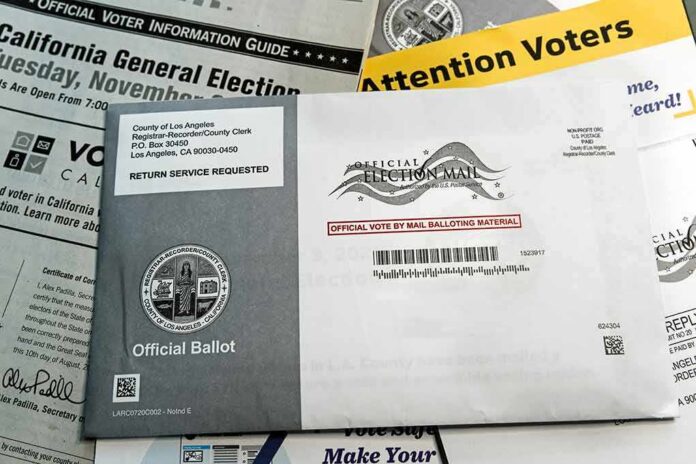
Courts do not manage elections; they manage risk. When judges freeze last-minute changes to ballot handling, they are protecting the system’s narrow margins for error. The whistleblower allegations about the U.S. Postal Service’s ballot-mail portal sit squarely in that frame: a compliance fight in which timing, process discipline, and legal authority matter as much as the technology itself.
At a Glance
- Federal court orders in Massachusetts enjoined core USPS ballot-mail changes for the 2026 election; a later temporary restraining order reiterated those restraints on key parts of the final rule.
- An anonymous USPS insider alleges work on a ballot-mail portal paused after the June injunction then resumed in late July without clear legal authority, continuing even after the August 27 TRO.
- The complaint describes a “zero percent” failure threshold in batch verification that could trigger mass rejections from a single mismatch; USPS has not publicly released the algorithm.
- USPS counters that it would not apply the rule to 2026 unless injunctions were lifted and says the court permitted continued development of an optional online tool.
The legal spine: what the courts actually ordered
Two Massachusetts orders set the legal posture. On June 25, 2026, a federal judge enjoined USPS from implementing Section 3 of the executive order for the November 2026 elections, blocking the agency’s ballot-mail provisions tied to new federal markings, barcodes, and eligibility gating. The order treated the changes as election-administration moves arriving too late and without clear statutory authority. That core logic held through August 27, when the same court granted a temporary restraining order staying USPS from implementing specified sections of the finalized “Ballot Mail for Federal Elections” rule—91 Fed. Reg. 54966—pending further proceedings. The sequence matters: injunction, then TRO against key parts of the final rule, both aimed at preventing operational rollout ahead of the midterms.
USPS has publicly emphasized a narrower reading: that while implementation is barred, preparation may continue. According to contemporaneous reporting, the agency said it would not apply the new rule to 2026 unless both injunctions were lifted, and that the latest restraining order still allowed development of an online tool for states that might opt in voluntarily. The court’s text is the touchstone; it enjoined implementation, not software existence. But the line between “building” and “implementing” in a fast-moving election context is exactly where compliance disputes live.
The whistleblower’s account: timelines and technical risks
The whistleblower disclosure transmitted through Senator Richard Blumenthal describes a development arc that began June 15, halted after the June 25 injunction, then allegedly resumed around July 29 without an articulated legal basis. The complaint further asserts work continued even after the August 27 TRO, characterizing the program as “secretive, rushed, chaotic, and fundamentally flawed”. Those are serious claims, not least because they speak to process control inside a safety-critical window—election mailings are not forgiving of late-breaking defects. The disclosure’s most vivid allegation is the “zero percent” failure rule: if a single record mismatch appears in a batch of ballots, the entire batch could be rejected, potentially holding back tens of thousands of otherwise valid packets until reprocessing.
This batch-rejection scenario is technically plausible in bulk-mail quality-control regimes—mailers use sampling and threshold logic every day. But elections are not catalogs; a false positive here is a voter who does not receive a ballot. What is missing from the public record is the system’s exact matching algorithm, error-handling pathways, and exception management. Without those, the difference between a hard “all-or-nothing” rule and a triage workflow (quarantining only the suspect pieces, releasing the rest) remains unresolved. That uncertainty is precisely why courts tend to freeze late-cycle changes: untested edge cases become systemic failures under peak load.
USPS’s defense: readiness and scope
USPS and the administration have framed the initiative as a verification overlay, not a content inspection. Leadership has said the aim is to match what states believe they are sending with what is actually sent, relying on established bulk-mail tooling and intelligent mail barcodes; the White House has similarly argued that the software task is not exotic given the Postal Service’s existing enterprise capabilities. The agency has also said it would not collect party affiliation and would not open sealed mail, addressing recurring privacy and politicization concerns. Those points are relevant—technical feasibility and data minimization matter—but they do not answer the litigation’s core question: what authority allows USPS to condition ballot transmission on a federalized eligibility check, and when can it stand up new controls during an active election calendar?
On timing, USPS has maintained that it issued the final rule to be ready the moment injunctions were lifted, not to sidestep them; and that development of an optional online tool remained permissible under the court’s order. If that interpretation holds, continued coding is not per se contempt. If the whistleblower’s account is correct that work crossed from preparation into steps the orders forbade, then the issue becomes factual: who authorized what, and how narrowly did they read the injunctions’ scope.
Mechanics and failure modes: why design choices matter
Ballot-by-mail systems operate under three unforgiving constraints. First, the delivery window is short; any hold-and-rework cycle eats days voters do not have. Second, address and identity data are messy by nature—name changes, diacritics, apartment numbering, and voter list churn create legitimate mismatches that robust systems must tolerate. Third, the adversary is time, not an attacker; most “attacks” are actually operational friction. In that environment, a zero-tolerance batch rule is a blunt instrument; it maximizes control at the cost of resilience. Well-designed verification layers isolate anomalies, elevate them to human review, and let the clean majority pass. They also provide auditable logs, transparent exception codes, and communication channels to election officials so that errors are corrected in hours, not weeks.
That is why the absence of a published technical specification is consequential. If the algorithm indeed treated a single mismatch as grounds to stop a whole batch, the risk of disenfranchisement by delay is obvious. If, instead, the tool simply flagged one piece and released the rest, the risk profile changes markedly. The available evidence supports the presence of late, active development and contested scope under court orders; it does not yet resolve the algorithmic design choice at the heart of the “catastrophic” claim.
Reading about the USPS whistleblower saying their new ballot tracking system might fail. I was going to vote by mail this year, but now I'm not so sure. Might just go in person.
— BRENEDUARD (@uviCWd8eA35IFSX) September 2, 2026
Where the record is strong, where it is thin
Strong: the litigation record. The August 27 TRO and related filings identify the specific final rule—Ballot Mail for Federal Elections—and confirm that core elements were under judicial restraint for the 2026 cycle. Strong: the whistleblower’s timeline of starts and stops around the June and August orders, now memorialized in the materials released through Senator Blumenthal’s office. Strong: public reporting of USPS’s own position that it would not apply the rule for 2026 unless injunctions fell, and its claim that continued development of an optional tool was permitted.
Thin: intent and chain of command. The documents in public view do not identify which USPS officials authorized post-injunction work or the legal memoranda they relied on. Thin: the technical proof. No publicly released code, test plans, or acceptance criteria confirm the “zero percent” batch rule beyond descriptions in secondary coverage. Thin: outcomes. Allegations point to projected risk; there is no evidence yet of ballots actually withheld or delayed by the challenged system during the enjoined window. These gaps are solvable: internal change logs, access records, counsel guidance, and a neutral technical audit would answer most open questions.
How to read this going forward
The posture here is not exotic in election administration. Agencies propose late-cycle controls; courts, wary of irreparable harm, freeze the status quo; insiders warn about rushed builds; and the public must parse complex claims through a partisan fog. The prudent test is simple. First, compare the injunctions to the actual work performed—dates, deliverables, and deployment steps. Second, audit the algorithm’s exception logic and batch-handling rules. Third, stress-test on real-world voter file noise. If USPS stayed within the court’s lines and built a resilient, minimal-friction tool, the controversy will recede. If it did not, the record will show it.
Sources:
twitchy.com, apnews.com, centraloregondaily.com, votebeat.org, blumenthal.senate.gov, democracydocket.com, yahoo.com
© conservativesense.com 2026. All rights reserved.