

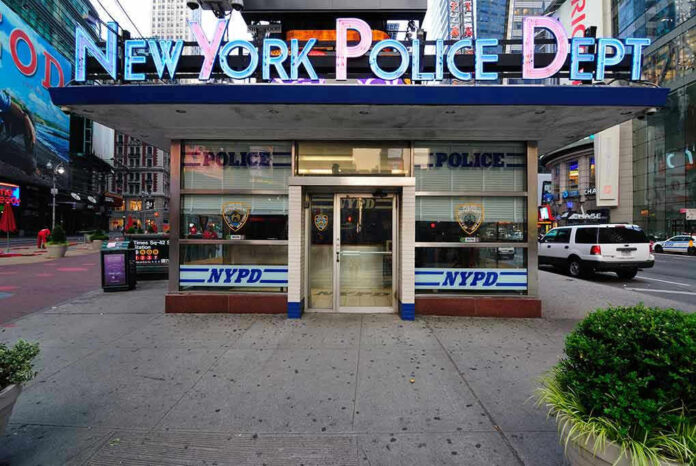
Security at America’s police stations faces new threats as a Bronx arsonist attacks officers with gasoline, exposing alarming vulnerabilities amid rising confrontations nationwide.
Story Snapshot
- A Bronx resident assaulted police officers with gasoline and set a decommissioned precinct on fire.
- Incident highlights growing security risks at unused law enforcement facilities.
- Mental health crises and attacks on police have escalated post-2020, raising policy concerns.
- Suspect was apprehended and faces multiple felony charges after immediate psychiatric evaluation.
Arson Attack Reveals Security Gaps at Decommissioned Police Precincts
On August 23, 2025, Samantha Calderon, a 32-year-old Bronx resident, allegedly poured gasoline from a Coca-Cola bottle onto a decommissioned police precinct on Alexander Avenue and ignited it, causing a brief blaze. When two NYPD officers responded, Calderon threw gasoline into their faces before being subdued and taken for psychiatric evaluation. This incident underscores the persistent vulnerabilities at unused police buildings, which often become targets due to reduced security and symbolic value in communities marked by social tension and unrest.
Bronx firebug throws gasoline on cops, lights old precinct on fire using soda bottle: NYPD https://t.co/mRY46usvHr pic.twitter.com/mFuoaNLBbb
— New York Post (@nypost) August 23, 2025
Law enforcement officials have warned that decommissioned precincts, left unguarded, expose officers and the public to unnecessary risk. The Bronx, long associated with arson and attacks on police property, remains a focal point for such violence. Recent years have seen a troubling increase in assaults on officers and property crimes, frequently tied to broader social unrest and mental health crises. Security protocols for unused facilities are now under review, as this attack demonstrates the urgent need for heightened safeguards and effective deterrence.
Mental Health Crisis and Public Safety Concerns
The Calderon case is the latest in a series of incidents where mental health intersects with criminal behavior, challenging law enforcement and medical professionals alike. Immediately following her apprehension, Calderon was transported to Lincoln Hospital for psychiatric evaluation—a step reflecting the growing recognition of mental health emergencies in violent confrontations. While her motivations remain unclear, experts emphasize that such events reveal systemic gaps in crisis intervention and the need for robust mental health resources capable of supporting at-risk individuals before they resort to violence.
Community advocates have long called for increased investment in mental health services, but law enforcement officials maintain that public safety and deterrence must remain top priorities. The balance between compassionate intervention and effective policing is delicate, especially as attacks on officers rise. The public debate now centers on how best to equip police to handle unpredictable, sometimes dangerous, individuals while preserving the safety of families and neighborhoods.
Legal Ramifications and Policy Responses
Calderon faces charges of arson, criminal mischief, assault, and resisting arrest, with the investigation ongoing to determine her precise motive and mental health status. The immediate response from NYPD—detaining the suspect and ordering psychiatric evaluation—highlights current protocols for handling such crises. However, law enforcement leaders are now pushing for legislative changes to improve security at decommissioned precincts, including increased funding for surveillance and patrols, as well as new training for officers dealing with mental health emergencies.
Bronx firebug throws gasoline on cops, lights old precinct on fire using soda bottle: NYPD https://t.co/VXxfFc1jM7
— ConservativeLibrarian (@ConserLibrarian) August 23, 2025
The attack’s aftermath has sparked calls for broader reforms. Local residents near Alexander Avenue have voiced concerns about safety and disruption, while political pressure mounts for a comprehensive strategy addressing both facility security and mental health intervention. The incident could set legal precedents for handling future cases involving direct assaults on police, especially those with underlying mental health factors. Nationally, law enforcement agencies may soon adopt stricter protocols for managing unused stations to prevent similar threats to officers and the communities they serve.
Broader Impact on Law Enforcement and Communities
The Bronx arson attack has immediate and long-term implications for police and local neighborhoods. In the short term, officers are demanding stronger security measures and more mental health training, while families nearby worry about continued public safety. Economically, increased spending on repairs and patrols is expected, further straining city budgets. Socially, the event reignites debate over police-community relations and the adequacy of mental health resources. As policymakers consider new legislation, this attack stands as a stark warning: without vigilant protection of law enforcement infrastructure and decisive action on mental health, America’s core values—security, order, and family—remain at risk.
Sources:
Bronx firebug throws gasoline on cops, lights old precinct on fire using soda bottle: NYPD
Maniac caught on video setting pit bull on fire in the Bronx