

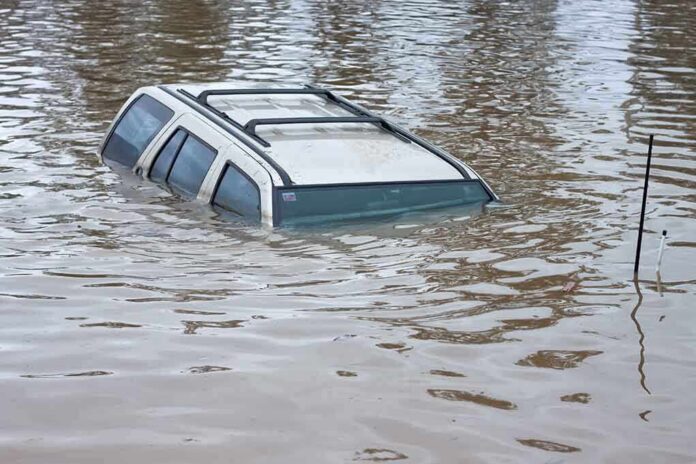
As deadly flash floods swallow Kentucky roads and homes, tech failures and government gaps leave families to fend for themselves.
Story Snapshot
- At least four Kentuckians are dead as flash floods swamp central and eastern counties.
- Governor Andy Beshear declares a statewide emergency while local counties struggle to cope.
- Social media alert failures and past policy neglect expose weaknesses in warning systems.
- Trump-era federal resources are available, but state and local leaders must use them wisely.
Deadly flooding slams Kentucky communities
On June 27, 2026, torrential rain hammered central and eastern Kentucky, turning streets into rivers and trapping families in their homes and cars.[12] Governor Andy Beshear confirmed at least four flood-related deaths, with three in Madison County and one in Jackson County.[13] Local reports describe basements filling with water, vehicles swept off roads, and a church in Madison County destroyed by raging floodwaters.[5] Flash floods struck fast, giving many residents little time to react or escape rising water.[13]
https://www.youtube.com/watch?v=WfNs1CZrjXM
The National Weather Service issued multiple Flash Flood Emergencies, its highest alert level, for communities including Richmond, McKee, and other hard-hit areas.[12] These emergencies are reserved for truly catastrophic situations where flooding is already life-threatening on the ground.[6] Radar and local measurements show rain totals climbing toward 7 inches in some counties, with localized amounts over 10 inches in parts of the state.[12] Floodwaters washed out roads and bridges, cutting off travel and leaving first responders to navigate dangerous currents.
State of emergency and local rescues
Governor Beshear declared a statewide state of emergency to unlock additional resources as water rescues multiplied across the commonwealth.[1] His office reports more than 60 rescues and evacuations as deputies, firefighters, and volunteers used boats and high-clearance vehicles to reach stranded residents.[13] Counties such as Bullitt, Madison, Meade, Mercer, and Spencer issued their own local emergencies as homes, churches, and small businesses took on water.[1] In Richmond, rescue teams went door to door in flooded neighborhoods, checking for trapped or missing people.[16]
State briefings note that at least 12 state roads were flooded or damaged, and several bridges were wiped out by the surge.[16] In Bullitt County, officials warned about a “moderate dam failure” near Lebanon Junction and urged families downstream to get to higher ground immediately.[13] Some water began to recede later, but local leaders warned the danger was far from over.[13] With Trump-era federal agencies ready to assist, the speed and skill of Kentucky’s state and county response will decide how many lives and homes can still be saved.
Warning systems and social media failures
Forecasters and meteorologists tracked the storm for days, warning that saturated ground and steep hills in eastern Kentucky could turn heavy rain into lethal flash floods.[6] Studies of past Kentucky floods show many residents still rely on local TV, the Weather Channel, and simple “looking outside” to judge risk, not official alerts alone.[18] During this event, at least one local weather broadcaster reported that Facebook failed to push live notifications for a critical emergency stream, limiting real-time reach to people in harm’s way.[2]
Content ranking systems and moderation rules on big platforms can quietly bury urgent weather coverage, even while lives are at stake.[2] For conservative readers who value personal responsibility and free speech, this raises serious concerns. Families did their part: watching the sky, checking roads, listening for sirens. Yet algorithms controlled by distant tech companies can still decide whether a warning appears on a phone screen in time. That kind of unaccountable power over life-and-death information should trouble every American.
Policy lessons, local control, and Trump-era priorities
This Kentucky disaster fits a long pattern: summer flash floods in the Ohio Valley that hit working-class, rural communities the hardest.[15] Past events in eastern Kentucky killed dozens and destroyed thousands of homes, but federal and state rebuilding has often been slow and tangled in bureaucracy.[9] Today, with President Trump back in the White House, federal agencies are again being pressed to cut red tape and get help directly to families, churches, and small towns instead of bloated programs.[10] That shift only matters, though, if state governments choose transparency and swift action.
Torrential thunderstorms unleashed life-threatening flash flooding across central Kentucky on Saturday, leaving at least four people dead across the state as floodwaters swallowed roads, neighborhoods and parkshttps://t.co/GEkz0aFPkd
— Dark Star (@thriftymaven) June 29, 2026
There are still no full public lists of victims, missing persons, or detailed dam inspection reports tied to this flood.[13] Conservative readers know how often delays, regulators, and insurance companies can drag out recovery and leave families in limbo. Real accountability would mean clear fatality records, honest engineering reviews of damaged dams, and fast claim processing so people can rebuild. As Kentuckians mop mud from their living rooms and pray over lost loved ones, they deserve more than headlines and political speeches; they deserve a system that works when the water rises.
Sources:
[1] Web – WATCH: Streets disappear beneath floodwaters as residents find …
[2] YouTube – KENTUCKY is Underwater Today! Storm, Flooding Swept Away Homes, Cars …
[5] YouTube – Scary Flash Flood in KY – June 18, 2026 – One of the Realities and …
[6] Web – Dramatic flash flooding turns deadly in Kentucky
[9] Web – Video Flash flooding prompts a state of emergency in Kentucky
[10] Web – Insights from the July 2022 Eastern Kentucky Flood
[12] Web – Heavy rain and flash flood risk on June 27, 2026 – Facebook
[13] Web – 4 dead as flash flooding slams Kentucky, triggering emergencies …
[15] Web – Flash flooding kills 4 in Kentucky, 1 in Tennessee, prompts …
[16] Web – The Flash Flood Disaster of July 1939 – National Weather Service
[18] Web – Multiple Flash Flood Emergencies have been issued across …
© conservativesense.com 2026. All rights reserved.