
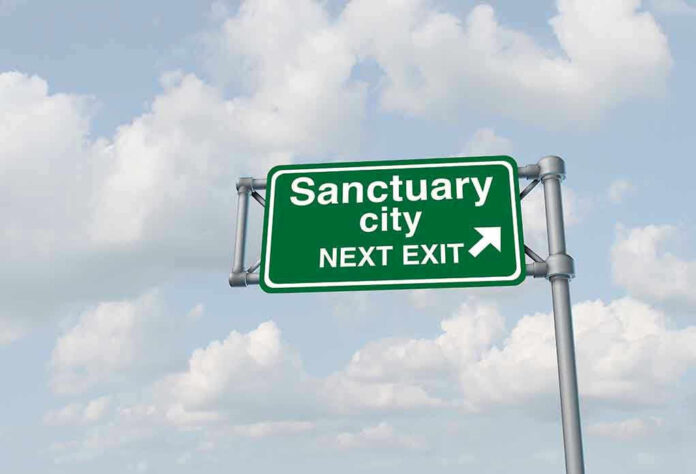
The Department of Justice has released a public list of 35 sanctuary jurisdictions, escalating legal threats against cities and states that refuse to cooperate with federal immigration enforcement and fueling the national debate over local autonomy versus public safety.
Story Snapshot
- The DOJ, under Attorney General Pam Bondi, published an official list of 35 sanctuary jurisdictions on August 5, 2025, targeting cities and states that limit cooperation with federal immigration authorities.
- This move follows a Trump executive order and signals renewed federal litigation and public pressure to force compliance with federal law.
- Some jurisdictions, like Louisville, have already changed policies in response to DOJ threats; others, such as Chicago, have successfully defended sanctuary policies in court.
- The list is not exhaustive and will be regularly updated as the DOJ intensifies scrutiny on local governments resisting federal immigration enforcement.
DOJ Increases Pressure on Sanctuary Jurisdictions
On August 5, 2025, the U.S. Department of Justice, led by Attorney General Pam Bondi, unveiled an official list naming 35 cities, counties, and states as sanctuary jurisdictions. These localities are accused of adopting policies that limit cooperation with federal immigration authorities, thereby, according to the DOJ, impeding law enforcement and endangering public safety. The announcement marks a sharp escalation by the federal government, which now threatens legal action and public shaming for jurisdictions resisting federal immigration enforcement.
The publication of this list follows a Trump executive order issued in April 2025, mandating that the DOJ identify and pursue litigation against sanctuary jurisdictions. The DOJ’s strategy combines the threat of lawsuits with efforts to sway public opinion, aiming to pressure local governments to abandon policies that, in the administration’s view, allow dangerous criminals to evade federal authorities. While some cities, such as Louisville, have adjusted their policies in response to DOJ warnings, others, including Chicago, have defended their sanctuary status in federal court and prevailed, highlighting the ongoing legal battle over this contentious issue.
Historical Roots and Ongoing Tensions
Sanctuary policies in the United States originated in the 1980s, as cities sought to protect undocumented immigrants from deportation and foster trust between law enforcement and immigrant communities. The term “sanctuary city” lacks a precise legal definition but generally refers to jurisdictions that restrict cooperation with federal agencies like Immigration and Customs Enforcement (ICE). Under the Trump administration’s renewed focus, the debate has reignited, pitting local and state autonomy against federal authority and sparking lawsuits that test the limits of constitutional power.
Most sanctuary jurisdictions are led by Democratic officials and are concentrated in states such as California, New York, Colorado, and Illinois. The DOJ’s latest move not only intensifies existing political divisions but also forces local governments to weigh the risks of legal action and potential loss of federal funding against their principles of local control and community trust. The issue has become a flashpoint in the broader battle over immigration and the balance of power between federal and local governments.
Legal Showdowns and Policy Shifts
Attorney General Bondi has made clear that the DOJ will continue bringing litigation against sanctuary jurisdictions and is working closely with the Department of Homeland Security to eradicate what the agency describes as harmful local policies. The DOJ’s list is explicitly “not exhaustive” and will be updated as more information is collected, signaling that more jurisdictions could soon face similar scrutiny. Some localities have responded to DOJ threats by changing their stance; for example, Louisville modified its policies to accommodate federal requests. However, other jurisdictions, like Chicago, have successfully defended their policies in court, with a federal judge recently dismissing a DOJ lawsuit and upholding the city’s autonomy.
The legal landscape remains uncertain, with ongoing litigation in several jurisdictions and the potential for precedent-setting Supreme Court involvement. The courts play a pivotal role in interpreting the constitutional boundaries between federal power and local autonomy. Recent decisions have reflected the enduring influence of the Tenth Amendment, which limits the federal government’s ability to compel localities to enforce federal law, but the DOJ’s aggressive posture suggests further legal battles are ahead.
For local officials and law enforcement, the stakes are high: noncompliant jurisdictions risk losing federal funds and facing mounting legal costs, while immigrant communities may experience increased fear of detention and deportation. The DOJ’s approach, combining litigation with public shaming, is designed to erode support for sanctuary policies and force local governments to prioritize federal immigration priorities over local values and relationships. Policy experts and legal scholars continue to analyze the broader impact, noting that the outcome of these legal conflicts will shape not only immigration enforcement but also the future of federalism in America.
Sources:
DOJ publishes official list of sanctuary cities
Bondi DOJ names and shames 35 sanctuary cities that ‘put American citizens at risk’
US Justice Department posts list of sanctuary jurisdictions, threatens more lawsuits
Map: Sanctuary Cities, Counties, and States