
A protest billed as “nonviolent” spiraled into concrete-throwing chaos outside a federal detention center—putting ICE agents and the rule of law back in the crosshairs.
Quick Take
- Thousands rallied in downtown Los Angeles for a “No Kings” protest on March 28, 2026, before a smaller group clashed with law enforcement near the Metropolitan Detention Center.
- Reports from local outlets described agitators throwing rocks, bottles, and chunks of concrete and trying to pull down fencing, prompting tear gas and an unlawful-assembly declaration.
- Arrest totals varied by reporting: local coverage described “dozens” and “over a dozen,” while viral claims circulated that roughly 75 were arrested.
- The event highlights a growing gap between organizers’ messaging and what unfolds on the street—raising fresh questions about public safety and enforcement of immigration law.
What Happened in Los Angeles—and Where the “No Kings” Narrative Broke Down
Los Angeles drew major crowds Saturday as “No Kings” organizers launched a rally at Gloria Molina Grand Park near City Hall and then marched through downtown. Local reporting described the daytime event as largely peaceful, but tensions escalated later near the Metropolitan Detention Center on Alameda Street—an area that has become a frequent flashpoint during protests tied to immigration enforcement. Police and federal agents ultimately moved to clear the area after confrontations intensified.
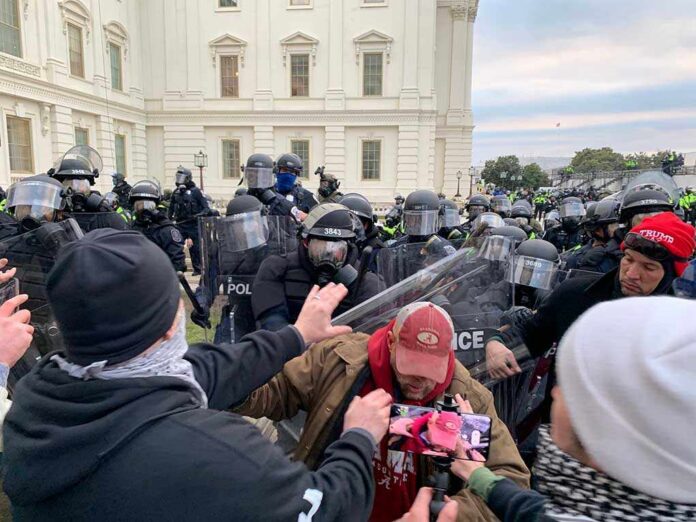
Video and eyewitness reporting indicated a smaller subset of protesters attempted to tear down chain-link fencing and threw objects—rocks, bottles, and pieces of concrete—toward law enforcement near the facility. Authorities responded with crowd-control measures that included tear gas, and an unlawful assembly was declared. By evening, police issued dispersal orders, established skirmish lines, and closed portions of Alameda Street as arrests began and the crowd was pushed back.
Arrests, Tactical Alerts, and What’s Confirmed Versus What’s Claimed
One reason this story is moving so fast online is that the arrest count is not reported consistently across sources. Local coverage confirmed arrests and showed multiple people in handcuffs, but some descriptions referenced “dozens” rather than a precise number. Viral posts and commentary circulated a higher figure—around 75 arrests—yet the available local reporting summarized in the research does not clearly corroborate that exact total. That uncertainty matters when claims are used to justify sweeping conclusions.
What is better supported is the operational response: the Los Angeles Police Department used dispersal orders, declared a Tactical Alert, and restricted traffic in the area to regain control. Reports also described federal agents physically confronting individuals at the perimeter of the detention center. With the downtown location so close to government buildings and major roadways, the city and state also used preemptive measures—such as freeway-ramp security gates—to limit disruptions seen in prior protests.
Why ICE Is the Flashpoint—and How That Intersects With “Endless Conflict” Fatigue
The “No Kings” movement has centered much of its energy on abolishing ICE and portraying immigration enforcement as authoritarian. In Los Angeles, that argument collides with a practical reality: the detention center is a federal facility, and when protests shift from speeches to fence-pulling and projectiles, the confrontation stops being political theater and becomes a public-order emergency. For many conservatives, protecting federal officers from targeted threats is not “politics”—it’s basic governance.
At the same time, the broader mood on the Right in 2026 is complicated. Many Trump voters are furious about years of globalist policy, inflation, and illegal immigration, but they are also increasingly skeptical of open-ended conflict overseas as the U.S. fights Iran and energy costs bite at home. That context helps explain why scenes of domestic disorder around immigration enforcement can provoke two reactions at once: support for law-and-order crackdowns, and suspicion that Washington is failing to prioritize Americans’ safety and affordability.
What This Means for Free Speech, Public Safety, and Limited Government
Americans have a constitutional right to protest, including harsh criticism of the President and federal agencies. But the reporting around this event underscores a bright line conservatives have warned about for years: when a protest turns into attempted property damage, projectile attacks, and disorder around secure facilities, government has a duty to restore order—without drifting into heavy-handedness that punishes peaceful demonstrators. The challenge is precision: target lawbreakers, not lawful speech.
INSANE! No Kings Protester Graffitis "KILL YOUR LOCAL ICE AGENT" on Federal Building in Los Angeles as Rioters Clashed with Federal Agents and Threw Concrete Blocks – 75 Arrested (VIDEO) | The Gateway Pundit | by Jordan Conradson https://t.co/H0qAyhqYu9
— Brian Baker (@Brian_D_Baker) March 29, 2026
Organizers touted massive nationwide participation, calling March 28 a “Day of Nonviolent Action,” while Republican-aligned voices and the White House dismissed the protests as deranged or politically funded. The available coverage supports a split-screen reality: large daytime crowds and a later nighttime pocket of violence near the detention center. That distinction is important because the country can’t have an honest debate about immigration—or the limits of protest—if leaders refuse to acknowledge what cameras captured.
Sources:
No Kings protests 2026: Chaos unfolds as thousands gather in downtown Los Angeles; arrests made
No Kings Day protest March 28: California locations