

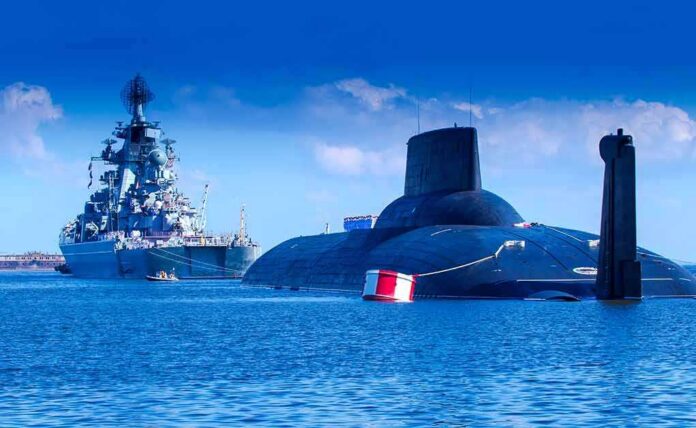
Canada is about to make a $43 billion submarine decision — and both Germany and South Korea are willing to give up their own subs to win the deal.
Story Snapshot
- Canada must choose between South Korea’s KSS-III submarine (Hanwha Ocean) and Germany’s Type 212CD (TKMS) for its new fleet.
- South Korea sailed a working submarine 14,000 kilometers to Canada so Canadian sailors could test it firsthand.
- Hanwha promises delivery of the first sub by 2032 — a full year ahead of Germany’s 2036 pledge.
- Both bidders are dangling massive economic packages, but neither set of job and GDP claims has been independently verified.
A Race Worth Billions — and Big Strategic Stakes
Canada’s Patrol Submarine Project is one of the largest defense contracts in the country’s history. The price tag sits around $43–44 billion. Two finalists remain: South Korea’s Hanwha Ocean with its KSS-III Batch II submarine, and Germany’s ThyssenKrupp Marine Systems (TKMS) with the Type 212CD. Both countries want this deal so badly that each has offered to delay or redirect submarines meant for their own navies to put Canada first.
Germany’s Defense Minister Boris Pistorius personally flew to Canada to guarantee delivery of four submarines by 2036. He called it “allied solidarity” and pledged an $86 billion economic package — including maintenance facilities on both coasts, a potential factory for torpedoes and hypersonic missiles, and energy projects in Alberta and Manitoba. Those figures have not been independently verified by any third party.
South Korea Sailed a Real Sub Across the Pacific to Prove Its Case
Hanwha took a bolder approach. The company sailed its operational KSS-III submarine, the Dosan Ahn Changho, roughly 14,000 kilometers from South Korea to Esquimalt, British Columbia. Canadian sailors were invited aboard to evaluate a fully working platform — not a proposal on paper. That kind of live demonstration is rare in defense procurement and hard to dismiss.[6]
Hanwha also promises to deliver the first submarine by 2032 and four boats by 2035 — one year ahead of Germany’s timeline.[2] The KSS-III Batch II combines Air-Independent Propulsion (a system that lets a sub stay submerged far longer without a snorkel) with lithium-ion batteries, making it one of the most advanced diesel-electric submarines in the world.[6] It also carries a built-in Vertical Launch System with 6 to 10 tubes for long-range land-attack missiles — a strike capability the Type 212CD does not match.[7]
Germany Argues NATO Ties Matter More Than Raw Firepower
Germany’s Type 212CD has real strengths too. It is a compact, very quiet submarine built for covert operations in shallow northern waters — a design that suits Canada’s Arctic approaches well.[4] Because Germany and Norway are building the same platform together, Canada would plug directly into an existing North Atlantic Treaty Organization (NATO) logistics and maintenance network from day one. That means shared spare parts, shared training, and shared technical knowledge with close allies.[1]
🇰🇷🇨🇦⚡South Korea's leading FLNG builder just signed a partnership on a 12 MTPA floating LNG project in Canada covering engineering, construction, equity, offtake AND submarines.
Hanwha Ocean signed an MOU with Kanata Clean Power for Kanata LNG a proposed FLNG export facility… pic.twitter.com/GO0tB2ZwyD
— Jack Prandelli (@jackprandelli) June 19, 2026
Germany’s bid also carries political weight. A trilateral letter of intent already links Canada, Germany, and Norway on this project. Defense experts like Philippe Lagassé have argued that NATO interoperability is not just a technical checkbox — it is a strategic signal about where Canada stands in the alliance. Splitting the contract between both bidders has been floated by officials, but defense experts warn that running two different submarine types would create a logistical nightmare and weaken the entire program.[14]
The Real Question: Capability Now or Alliance Comfort?
Both economic packages — Hanwha’s projected $94.1 billion Canadian dollar gross domestic product impact and 22,500 annual jobs, versus Germany’s claimed $86 billion and 50,000 jobs — are self-reported figures.[6] No independent audit has confirmed either number. Canada should demand verified data before letting job-creation promises drive a decision this large.
The honest case for South Korea comes down to this: the submarine exists, it works, it showed up in Victoria, and it arrives sooner. The honest case for Germany is that NATO integration and Arctic stealth matter enormously for Canada’s specific geography and alliance commitments. Canada’s government owes its citizens a transparent, merit-based decision — not one driven by political pressure from European capitals or unverified economic promises from either side.[2]
Sources:
[1] Web – Canada Is About to Choose Its Next Submarines. Germany and South Korea …
[2] Web – KSS (Korea) vs Type 212 (Germany) — Which Submarine … – Canada
[4] Web – Canada’s Submarine Future: Evaluating German and …
[6] YouTube – Type 212CD vs KSS-III Submarines, Which One is Best for Canada?
[7] YouTube – Type 212CD vs KSS-III: Germany and Korea Battle for Canada’s New …
[14] Web – [PDF] Deeply Complicated: Canadian Submarine Procurement Options
© conservativesense.com 2026. All rights reserved.