
A Michigan Senate candidate who built his campaign on getting money out of politics spent an evening at a Hollywood mansion where guests could write checks worth $57,800 each.
Story Snapshot
- Democratic Senate candidate Abdul El-Sayed attended a California fundraiser hosted by Jeffrey Soros, nephew of billionaire George Soros.
- The invitation allowed donors to give up to $57,800 per person to the Abdul for Michigan Victory Fund.
- Jeffrey Soros said his family helped pay for El-Sayed’s tuition starting in 2012.
- Federal filings show El-Sayed raised $14.5 million, with most of it coming from individual donors, including millions in large checks.
Hollywood Fundraiser Draws Scrutiny
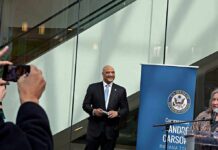
Fox News reported on September 17 that El-Sayed, who campaigns on getting “money out of politics,” attended a meet-and-greet at the West Hollywood home of Jeffrey Soros and his wife, Catharine Soros. A flyer for the event listed contribution levels reaching $57,800 per person to the Abdul for Michigan Victory Fund, a joint fundraising account tied to the campaign.
During the closed-door gathering, Jeffrey Soros told attendees his family’s fellowship program had covered El-Sayed’s tuition and living costs dating back to 2012. The disclosure added a personal layer to a fundraiser that was already drawing attention for its price tag and its ties to one of the most recognized names in Democratic donor circles.
Republican Rival Calls Out the Contrast
Michigan Republican Senate nominee Mike Rogers labeled El-Sayed a “con man” over the fundraiser, pointing to the gap between the candidate’s rhetoric and the guest list in Hollywood. Republican strategists and commentators have pressed Democratic operatives, including former campaign communications staffers, to explain how a candidate running against big money squares that message with six-figure fundraising swings funded by wealthy coastal donors.
El-Sayed has pushed back, arguing that outside spending from groups like MAGA Inc. and a political action committee tied to Elon Musk is the real problem in the race. He has pointed to the $70 million spent during the primary alone as evidence that big money already distorts Michigan’s Senate contest, regardless of who benefits from it.
What the Campaign Finance Numbers Show
Federal Election Commission records covering January 2025 through July 2026 show El-Sayed’s campaign took in $14,514,335.93 in total receipts, with $14,408,058.06 of that classified as individual contributions, about 99.3 percent. His campaign has repeatedly said it has “never taken a dime of corporate PAC money” and is “100% funded by people like you — not corporations and would-be oligarchs”.
Those claims are technically accurate, since no corporate PAC checks appear in the filings. But the same records show more than $5.2 million came from contributions of $2,000 or more, and roughly $8.5 million came from gifts of $500 or more. That means a large share of his war chest came from donors capable of writing big checks, not the small-dollar grassroots giving his campaign emphasizes in its messaging.
A Pattern Bigger Than One Candidate
El-Sayed is far from the first “anti-big-money” candidate to lean on wealthy backers. Senator Elizabeth Warren pledged in 2019 to skip high-dollar receptions during her presidential run, while even Senator Bernie Sanders, known for small-dollar fundraising, accepted some large donations along the way. Campaign finance researchers note that in competitive federal races, outside spending and bundled money from top donors keep growing even as small-donor platforms expand.
That dynamic fuels a recurring frustration for voters across the political spectrum: candidates who promise to fix a broken system often end up working inside it to compete. Whether El-Sayed’s fundraising crosses from necessity into contradiction is a judgment call for voters, but the numbers and the Hollywood guest list are not in dispute.
In a pointed exchange on The Story, Martha MacCallum pressed Michigan Democratic Senate candidate Abdul El-Sayed on the gap between his repeated calls to get money out of politics and his own fundraising. MacCallum cited his campaign-trail remarks about billionaire oligarchs and… pic.twitter.com/UnAkWPCw2O
— Upward News (@UpwardNewsHQ) October 5, 2026
The Michigan Senate race now heads toward November with both campaigns trading accusations over money in politics, even as both sides continue raising it at scale. For many voters already skeptical of Washington, the episode reinforces a broader sense that campaign finance reform remains more slogan than practice, no matter which party is making the pitch.
Sources:
youtube.com, yahoo.com, ground.news, foxnews.com, pjmedia.com, jewishinsider.com, vinnews.com, abdulforsenate.com
© conservativesense.com 2026. All rights reserved.