
Tennessee pumped two doses of a lethal drug into Christa Gail Pike and she still would not die.
Story Snapshot
- Tennessee tried to execute Christa Gail Pike on September 30, 2026, using two doses of pentobarbital, but she survived.
- Her lawyers said she lost consciousness but still had a heartbeat and was audibly snoring during the attempt.
- Witnesses confirmed Pike was alive and loudly snoring before she was taken from the prison by ambulance.
- Governor Bill Lee ordered an outside review and paused the state’s one remaining execution set for 2026.
- Experts call it the worst botched lethal injection in modern American history, with no real precedent.
What Happened Inside The Death Chamber
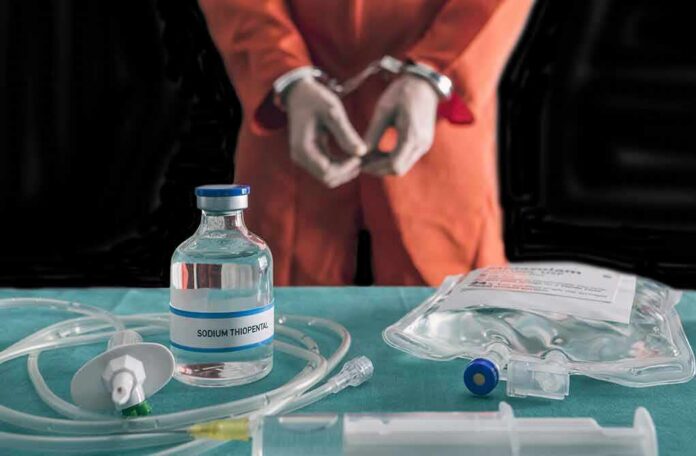
The Tennessee Supreme Court had ordered the Warden of Riverbend Maximum Security Institution to carry out Pike’s death sentence on September 30, 2026, for a 1995 murder she committed at age 18. Officials followed through, administering a first dose of pentobarbital. When Pike did not die, they gave her a second dose. She still did not die.
Multiple news outlets, relying on wire reporting from the Associated Press, confirmed that state officials gave Pike two full doses of the lethal drug before halting the process entirely. That detail alone sets this case apart. Lethal injection protocols are built around a single, supposedly fatal dose. Needing a second dose, and still failing, points to a breakdown far beyond a routine complication.
Lawyers Describe A Woman Still Breathing
During the attempt, Pike’s attorneys filed an emergency motion telling the court something urgent. They said, “Ms Pike has lost consciousness and still has a heartbeat and is audibly snoring”. That filing landed while the execution was technically still underway, a detail that turns a legal document into a real-time account of a process going wrong in front of witnesses.
Media witnesses inside the viewing room backed up the account. They described Pike as alive and loudly snoring after the drugs were administered. She was then removed from the execution chamber and taken away from the prison by ambulance, not a hearse. The state had planned a death. It ended with a medical transport.
The State Says It Followed The Rules
The Tennessee Department of Correction did not dispute what happened. Instead, it defended how it happened. The department said it “followed every step of the State’s lawful, established execution protocol approved by the Attorney General’s Office.” That statement focuses on procedure, not outcome. Following the rulebook and successfully carrying out a death sentence are, this case shows, two very different things.
Governor Lee Hits Pause On The Next Execution
Governor Bill Lee responded by ordering what reporting described as a comprehensive, third-party review to determine exactly what occurred. He also confirmed that Tennessee’s one remaining scheduled execution for 2026 will not happen this year. A governor who had just denied Pike clemency, saying he was “upholding the sentence,” was now pumping the brakes on the entire system days later.
Experts Say This Has No Real Precedent
Robin Maher, executive director of the Death Penalty Information Center, did not mince words. “This event is the worst we’ve seen and unlike any other botched execution in the modern era,” she said. “There is no precedent”. That is a strong claim from someone who studies execution failures for a living, and the facts on the ground back it up.
Yes, Christa Pike did make that infamous statement. Following the 1995 murder of Colleen Slemmer, Pike bragged about the prolonged attack and notoriously remarked that "the bitch wouldn't die". This quote recently resurfaced due to the irony of Pike surviving a botched execution…
— Annette (@AnnetteRMC) October 2, 2026
Maher’s warning fits a pattern researchers have tracked for decades. The Death Penalty Information Center estimates roughly 3 percent of executions between 1890 and 2010 were botched in some way, and lethal injection carries the highest failure rate of any method ever used in the United States. More recent numbers look worse, not better. Analysts found seven of nineteen execution attempts in 2022 alone were flagged as problematic. Tennessee had already struggled earlier in 2026 when medical staff could not find a usable vein during a separate execution attempt. Pike’s case did not come out of nowhere. It landed at the end of a long, documented slide in a method states still call humane. A single brief caveat applies here: the full internal timeline of what happened between the second dose and Pike’s removal from the chamber has not yet been made public, and the governor’s review is meant to fill that gap.
Sources:
cnn.com, bbc.com, tncourts.gov, abcnews.com, lawcommentary.com, deathpenaltyinfo.org
© conservativesense.com 2026. All rights reserved.