

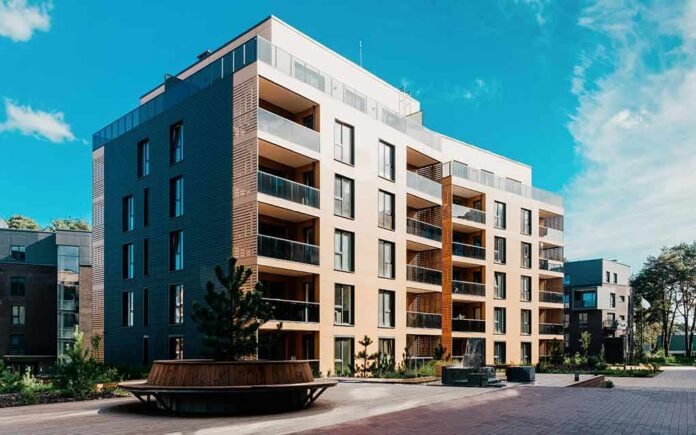
What looks miraculous in a headline is, on closer inspection, a textbook interaction between physics, building design, and luck: a University of Georgia student survived an eight-story fall because her descent intersected with a pool deck and metal furniture that dissipated energy before final impact, while the window she exited lacked the last barrier that would have prevented the fall in the first place.
The Short Version
- A 21-year-old UGA student fell from an eighth-floor window at the Rambler Athens complex and survived after striking a pool deck and a metal bench/chair on the way down.
- Police describe the fall as accidental; reporting traces the sequence to dancing on a couch near an open, screened window.
- Management later reminded residents that windows have safety limiters (restrictors) and warned against tampering; whether a limiter was engaged at the time is not established in public reports.
- The case fits a broader pattern: window falls in student housing frequently involve climbable furniture near operable windows and the failure or absence of effective opening restrictors.
What happened and why she lived
Athens-Clarke County police and multiple outlets report that the student fell from an eighth-floor apartment at Rambler Athens on West Broad Street and landed on the complex’s pool deck below. The incident occurred early Saturday evening; responding officers described it as accidental. Accounts consistently trace the precipitating action to movement atop furniture near an open, screened window—variously described as dancing on a couch or jumping between a couch and mattress—followed by a fall through the opening. Critically, the student’s trajectory intersected with a metal bench or chair on the deck, which appears to have absorbed and redistributed part of the kinetic energy that otherwise would have transferred entirely to her body on final impact.
Survival from such height is unusual but not inexplicable. Vertical fall outcomes are governed by impact surface compliance, intermediate collisions that change momentum vectors, and body orientation at impact. Hitting elastic or frangible structures—awnings, branches, or, in rare cases, outdoor furniture—can lower peak deceleration. Forensic reconstructions of high-rise falls routinely account for obstacles and wind as modifiers of the terminal event; small changes in path can mean large differences in survivability. In this incident, the combination of a pool deck level below (not open grade) and intervening metal furniture created precisely the sort of energy-dissipating sequence that improves odds, even at heights that often prove fatal.
The built environment mechanics: screens, restrictors, sill heights, and furniture
Three design elements control window-fall risk in multifamily housing: how far a window can open (opening limit), how high its bottom edge sits above the interior floor (sill height), and what is placed within reach inside the room (furniture that enables climbing). Many jurisdictions address the first two through codes and standards. Under widely adopted model codes, operable windows located more than 72 inches above exterior grade must either sit at least 36 inches above the interior floor or be equipped with fall-prevention devices—window limiters or guards—that restrict openings to roughly four inches while still permitting ventilation and emergency egress. Restrictors are simple mechanical stops; high-quality units cap opening widths around 100 millimeters and are designed to be difficult to defeat casually.
Screens are not part of that safety system. They keep insects out; they are not engineered to keep people in. Housing handbooks and injury-prevention literature repeat the same blunt warning: do not trust a screen to arrest a fall. The moment a person’s center of mass moves beyond the sill through an open, screened window, the screen will almost certainly fail. The behavioral component is likewise consistent: placing couches, beds, or desks against low or mid-height windows creates an easy platform for elevated activity near the opening, which multiplies risk.
How this case aligns with the risk pattern
The Rambler Athens incident sits precisely at the intersection of those risk factors. Police narratives and resident interviews describe an open, screened window, active movement on furniture abutting that window, and a subsequent fall from the eighth floor to a lower-level deck. After the event, building management reminded residents that the windows are equipped with safety limiters and urged them not to tamper with those devices—language that mirrors best-practice guidance across student housing stock. Public reporting has not established whether the limiter on the affected window had been disengaged, malfunctioned, or was irrelevant given the configuration; what is clear is that a screen alone proved no barrier once the opening was breached.
This pattern is not idiosyncratic to one property. Decades of epidemiological work on window and balcony falls highlight two modifiable conditions: low sill heights without compliant guards, and climbable or moveable furniture positioned where a person—often impulsively—can defeat the effective barrier. In one classic series, most recorded window falls occurred in apartments, with time-of-day and use-pattern clusters that map onto periods of active household movement. Student housing adds its own accelerants: frequent furniture rearrangements, lofted bedding, and social activity that pushes behavior toward windows and railings unless the built environment is designed to make that mistake hard to make.
Energy transfer, explained without the mystique
An eight-story free fall approaches terminal velocities that would normally be unsurvivable on concrete. What changed the math here was the introduction of intermediate, deformable structures. When a person strikes an object that bends, breaks, or moves—such as a metal bench—the impulse (force over time) is spread out. Peak g-loads drop, injuries shift from universally lethal to severe but survivable, and secondary contact with the deck occurs at a lower residual velocity and a different body orientation. Investigators in fall reconstructions explicitly model these interactions; the presence of obstacles like furniture is not an incidental detail but a primary determinant of outcome. In short, the bench did not “catch” the student so much as it failed productively, buying just enough time and distance for biology to have a chance.
Accountability and prevention: what actually works
Prevention in this domain is not mysterious, and it rarely requires exotic technology. The hierarchy is straightforward: specify compliant window systems with integral restrictors in rooms where sills are within easy reach; set or retrofit sill heights to safe values where feasible; enforce policies that keep beds, couches, and desks off the window wall; and educate residents that screens are not safety devices. High-quality restrictors—properly installed and maintained—limit openings to about four inches while preserving ventilation; they are inexpensive relative to the consequence of a single failure. Residence-life policies that require safety stops to remain intact and assign responsibility for reporting damaged screens or restrictors create operational redundancy, but only if they are actually enforced and audited.
The Rambler Athens post-incident message tracked those principles closely: remind residents that restrictors exist, warn against tampering, and invite maintenance reports. The crucial next layer, for any operator, is verification—routine inspections, tamper-evident hardware, and room configurations that physically prevent furniture from abutting windows in high-rise units. Codes set the floor; management practice determines whether those protections are real at 8 p.m. on a Saturday when the room is in motion.
A 21-year-old student at the University of Georgia is alive and talking after surviving a fall from an eighth-floor apartment. https://t.co/UZWIcgwxQ9 pic.twitter.com/DxZKHvCXxW
— ABC News (@ABC) October 1, 2026
Why this matters beyond one remarkable survival
It is tempting to frame this as a miracle and move on. The better lesson is design humility. When human behavior predictably brings people near edges and openings, the right question is not whether they will someday lean too far, jump, or dance; it is whether the environment will forgive the mistake. Modern building codes, restrictor hardware, and furniture policies give owners and universities the tools to make forgiveness the default. The UGA student survived because physics and chance collaborated on the way down. The goal is to make sure the next student never goes over the sill in the first place.
Sources:
foxnews.com, nbcnews.com, wsbtv.com, fox5atlanta.com, yahoo.com, independent.co.uk, wsbradio.com, themirror.com, livemint.com, wuga.org
© conservativesense.com 2026. All rights reserved.