

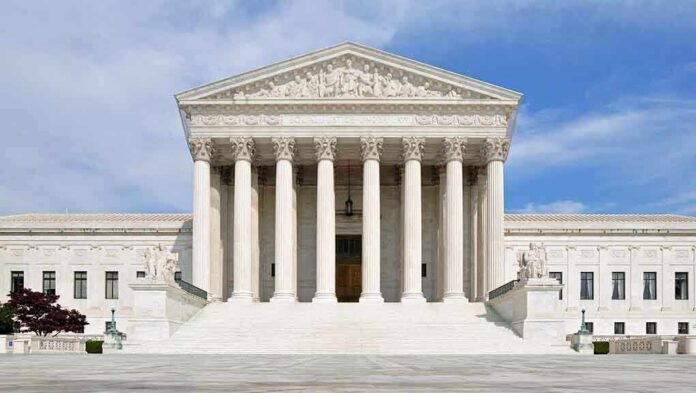
The Supreme Court drew a hard line on presidential power, upholding birthright citizenship while curbing White House tariff authority, and the split rulings expose how both parties now clash with a system many Americans say no longer serves them.
Story Highlights
- The Court rejected President Trump’s order limiting birthright citizenship, citing the Fourteenth Amendment.
- The Court held the emergency economic law does not let presidents impose tariffs without clear approval from Congress.
- The birthright case cements a broad rule: most children born on U.S. soil are citizens at birth.
- Both rulings reinforce Congress’s central role in setting citizenship and trade policy.
What the Court Decided on Birthright Citizenship
On June 30, the Supreme Court ruled that children born in the United States are citizens even if their parents are in the country illegally or on short-term visas. The opinion interpreted the Fourteenth Amendment’s text and history to reject President Trump’s executive order, which aimed to narrow who counts as “subject to the jurisdiction” of the United States. Major outlets and civil-liberties groups described the decision as a firm reaffirmation of the long-standing rule of birthright citizenship.
The case, Trump v. Barbara, centered on Executive Order 14160. The administration had argued it was applying the Amendment and a citizenship statute rather than rewriting the Constitution. The Court disagreed. It read the Citizenship Clause to cover most people born on U.S. soil, relying on text, Reconstruction-era sources, and past cases. The ruling blocks agencies from denying documents that recognize citizenship to these children going forward.
How the Tariff Ruling Limits Executive Power
On February 20, the Court decided Learning Resources, Inc. v. Trump. The majority held the emergency economic law known as the International Emergency Economic Powers Act does not give presidents the power to impose tariffs. The justices noted the statute lacks any mention of tariffs or taxes. They said large economic steps like nationwide import duties need clear approval from Congress before a president can act on his own.
Coverage of the ruling stressed separation of powers and money. Reporters explained that the Court saw tariffs as a form of taxation and trade regulation that belongs to Congress. Analysts also said the Court used a “major questions” approach, which asks for very clear words from Congress before allowing big policy moves by an agency or the White House. The decision strikes at the core of a tool recent presidents used to pressure foreign economies.
Why These Rulings Matter Beyond the Headlines
Together, the cases show the Court enforcing guardrails on presidential power in two hot areas: immigration and trade. In citizenship, the Court stuck with a simple, stable rule that most children born here are Americans. In tariffs, the Court told the White House to go back to Congress if it wants broad, lasting duties. For citizens who feel elites bend rules while families face rising costs, the message is clear: process matters and shortcuts face pushback.
John Roberts has long advocated for maximum Presidential authority. “History’s little joke is that the President currently enjoying this generous new interpretation of his powers is surely not the mannerly, norm-abiding Republican Roberts had in mind decades ago,” Margaret Talbot… pic.twitter.com/6nH1D7yIQL
— The New Yorker (@NewYorker) August 11, 2026
These rulings also reflect a bigger trend. Presidents from both parties often test the edge of their legal powers when Congress stalls. Courts then step in to say what the law allows. That pattern can frustrate conservatives who want swift border control and lower energy costs, and liberals who want stronger safety nets and fairer wealth rules. But it also points to a shared truth many now voice: lasting change needs clear laws, not quick fixes that courts will undo.
What Changes Next for Policy and People
On birthright citizenship, the main change is certainty. Hospitals, state offices, and federal agencies will continue treating most U.S.-born children as citizens at birth. Families will have clearer paths to documents and services. On tariffs, the White House must seek new laws to raise broad duties or redesign trade leverage. Congress can still act, but it must debate and vote in the open, which could slow action yet produce more stable rules for workers, farmers, and consumers.
Sources:
reason.com, supremecourt.gov, cnbc.com, npr.org, fam.state.gov, brennancenter.org, forumtogether.org
© conservativesense.com 2026. All rights reserved.