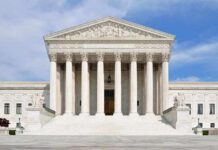


Three pivotal Supreme Court cases could reshape American values, spotlighting issues of constitutional rights, fairness in sports, and presidential powers.
Story Highlights
- Supreme Court to hear cases on transgender athletes, Second Amendment rights, and Trump’s authority over the Federal Reserve.
- Transgender athlete cases challenge fairness in women’s sports, raising constitutional questions.
- Gun rights case tests the limits of public carry on private property under the Second Amendment.
- Trump’s attempt to fire Fed Governor Lisa Cook could redefine executive powers over independent agencies.
Transgender Athlete Cases: A Test of Fairness and Title IX
The U.S. Supreme Court is set to hear two major cases involving transgender athletes, Little v. Hecox and West Virginia v. B.P.J., addressing state bans on transgender participation in women’s sports. These cases have sparked intense debates over fairness and Title IX interpretations. They stem from Idaho and West Virginia laws enacted to preserve competitive equity in female sports, challenging the balance between inclusion and fairness.
These cases raise fundamental questions about the interpretation of sex discrimination laws and their application to transgender individuals. As the court considers these matters, the decisions could have significant implications on state policies and nationwide standards for gender identity in sports.
Gun Rights and Private Property: Wolford v. Lopez
Another crucial case, Wolford v. Lopez, will test Second Amendment rights concerning carrying firearms on private property. The challenge arises from Hawaii’s law requiring a permit-plus-permission model, which critics argue effectively nullifies the right to bear arms. Gun rights advocates contend this violates the Supreme Court’s precedent set in NYSRPA v. Bruen, demanding historical analogs for restrictions. The ruling could redefine the scope of gun rights and influence state legislation across the country.
As gun owners and rights organizations watch closely, the outcome of this case could either fortify or weaken public carry rights, impacting the ongoing national discourse on gun control and individual liberties.
Trump v. Cook: Presidential Powers at the Forefront
The third major case involves President Trump’s attempt to remove Federal Reserve Governor Lisa Cook, which has been blocked by lower courts. The case, Trump v. Cook, questions the president’s authority to dismiss officials from independent agencies. The court’s decision may set a new precedent for executive power, potentially enabling broader control over federal agencies. This case revisits the longstanding debate over the separation of powers, underscoring the tension between executive authority and agency independence.
3 Key Supreme Court Cases to Watch in Early 2026 https://t.co/BUAbwmuldj
— David Trotter (@DavidTr78580308) January 2, 2026
Each of these cases carries significant weight, influencing not only legal frameworks but also political and social landscapes, reflecting the ongoing cultural and institutional battles within the country.
Sources:
Supreme Court Oral Arguments Calendars and Lists
5 Far-Reaching Supreme Court Decisions to Watch for in 2026